Muskoka Bird Board - Archived Reports from July - September 2011Return to the Index of Archived Reports
Go to the Muskoka Bird Board
Bluebirds
Posted
on September 30, 2011 at 08:11:27 PM by carolwagg
We were delighted this morning to have a family of four bluebirds drop in for
about 15 minutes, scoping out the birdboxes. We hope to see them again next
April. (Doe Lake Rd., Gravenhurst)
White-winged Scoter
Posted
on September 30, 2011 at 10:19:30 AM by jim
griffin
At this moment, there is what I have identified, with the help of my scope and
Mr. Sibley,a first winter juvenile White-winged Scoter on the river south of
the Indian Landing at Port Sydney
Re(1): Rusty
Blackbirds near Bracebridge
Posted
on September 30, 2011 at 12:52:50 PM by Al
Sinclair
2 Rustys here today. Foraging on the lawn, turning over leaves and picking
around in the grass. Also flew into our mountain ash tree looking under leaves
and in the berry clusters, one took a bite out of a berry but that's all.
Also in the mountain ash today, 4 Robins and 1 Hermit Thrush all swallowing
whole berries.
Rusty Blackbirds
near Bracebridge
Posted
on September 29, 2011 at 02:09:52 PM by Al
Sinclair
We had 6 Rusty Blackbirds on the lawn today. Saw one catch a caterpillar. 8km
east of Bracebridge. photo
Horned Lark, Rusty
Blackbirds - Bracebridge Ponds
Posted
on September 29, 2011 at 01:34:59 PM by Barbara Taylor
This morning at the Bracebridge Ponds there was a Horned Lark about mid-way
along the north side of cell 3, where there is a large weed-covered gravelly
area next to the road. Several Rusty Blackbirds were in the wet woods north of
cell 4. A Northern Flicker, Yellow-bellied Sapsucker, and four Green Herons
were in the vicinity of cell 4. A few Palm Warblers and Common Yellowthroats
were near the SW corner of cell 4 along with many Sparrows (White-crowned,
White-throated, Swamp, Song, and a Savannah). At least twenty American Pipits
were feeding along the roadway at the south side of cell 3. An Indigo Bunting
was near the Lagoon Lane gate. No shorebirds were seen and not a single Canada
Goose. Here are the waterfowl seen:
American Wigeon - cell 2 and cell 3
Common Goldeneye - cell 1 and cell 4
Northern Shoveler (F) - cell 2
Pied-billed Grebe - cell 3 (SW corner)
Hooded Merganser - cell 4
Blue-winged Teal - cell 2 and cell 3
Green-winged Teal - cell 2
Wood Ducks and Mallards - all cells
Warblers
Posted
on September 29, 2011 at 11:25:35 AM by CatMacLean
I am still seeing warblers moving through.Black-throated Blue and Nashville as
well as a larger bird with a yellow body and green wings, ? a tananger? Also
seeing Phoebes, Chipping sparrows and a Golden-crowned Kinglet.
Re(3): Monarchs
Posted
on September 29, 2011 at 03:10:48 PM by Barbara Taylor
This morning at the Bracebridge Ponds there were a few Monarchs slowly working
their way southward. Also a couple of Viceroys, and one Sulphur butterfly which
looked a bit more orange than the usual Clouded Sulphurs we've seen there.
Re(2): Monarchs
Posted
on September 28, 2011 at 04:56:50 PM by Eleanor
Kee Wellman
There are four here today in the Stiff Goldenrod.
Also had a feeding flock around just after the rain stopped about noon. RB
& WB Nuthatches, chickadees, Brown Creepers, kinglets and YR Warblers.
Re(1): Monarchs
Posted
on September 27, 2011 at 10:12:21 PM by dinnymccraney
at least 6 on the sedum south L. Muskoka yesterday
Monarchs
Posted
on September 27, 2011 at 06:48:21 PM by DebbieAdams
Today we spotted 2 Monarchs within 4 hours of each other flying in a SSE
direction. (Walker's Point)
Blue Jays
Posted on
September 27, 2011 at 06:46:01 PM by DebbieAdams
There are at least 30 Blue Jays that are feasting on beech nuts around our
property and in the woods. Mostly, they are grabbing nuts from the tops of the
trees, knocking others down much to the delight of the Chipmunks. And they are
making quite a racket too! (Walker's Point)
Mallard Autumn
courtship
Posted
on September 27, 2011 at 07:06:34 AM by George
Bryant
For the past three evenings at dusk, we have observed a pair of Mallards swim
across our lake into our bay where the female seems to scout out a nesting site
on shore. The pair then fly off together. This is an activity I have observed
many times before but only in April and May. We see a lot of courthip behaviour
in wintering ducks but Mallards, seemingly may begin pair formation even before
migrating.
Swainson's thrush?
and others
Posted
on September 25, 2011 at 09:43:36 PM by John
Challis
A pine warbler was singing on the Green River (Washago), as the morning sun was
warming the riverbank today.
And a few days earlier I was up just before dawn listening to an odd call I
couldn't identify; there are a lot of those this time of year. It was a
mid-range 'peep' followed by a whirr, a bit like a red-bellied woodpecker's,
but not quite. Today I sat down with the Stokes CD of calls and I came closest
with the Swainson's thrush. It's possible one was migrating through, I suppose,
but that's an uneducated guess.
We've also had a barred owl in the yard for a few days. Given the quantity of
mole runs in the yard, it's not surprising that the owl would find our place
appealing.
Re(1): Monarch,
Bala
Posted
on September 28, 2011 at 09:49:14 AM by Barbara Taylor
I guess it would depend a lot on how sunny and mild the weather is and how the
wind patterns shape up in a particular year. According to one source I found
online, Monarchs can't fly if the temperature is less than 13°C., and Journey North
says "in order to fly, monarchs need temperatures at least 50°F when sunny
and at least 60°F when cloudy".
When conditions are good, Monarchs are able to cover a fair distance...I found
two cases where tagged Monarchs were released and then recovered the very next
day at 170 miles and 265 miles from their starting points. There has been a lot
of Monarch tagging over the past few years, so perhaps as more data is
collected, a better picture will emerge on potential late flight survival.
Monarch, Bala
Posted
on September 25, 2011 at 07:17:13 PM by Eleanor
Kee Wellman
I have a single Monarch for the last few days. It has been nectaring on the
Stiff Goldenrod, a native of the prairies that comes in the Prairie Wildflower
mix for sept beds that I planted 6 years ago this fall.
I read that these late flyers are not likely to make it to Mexico. Are there
different opinions on that?
Wigeon, Pipits -
Bracebridge Ponds
Posted
on September 25, 2011 at 12:53:58 PM by Barbara Taylor
This morning at the Bracebridge Ponds we found an American Wigeon in cell 3
along with a female Northern Shoveler, a Pied-billed Grebe, Green-winged Teal,
Blue-winged Teal, Wood Ducks, and Mallards. An American Black Duck was with
several Mallards in cell 2. The Solitary Sandpiper was still on the small strip
of muddy shore at the south end of cell 1. A few American Pipits were near the
NE corner of cell 4. Two Common Goldeneyes and two Hooded Mergansers were in
cell 4. Several Canada Geese came in from the north and landed in cell 4. Two
Green Herons were once again in the ditch north of cell 4. There were some Palm
Warblers and Yellow-rumped Warblers in the shrubbery near the SW corner of cell
4.
Bracebridge Ponds Map (north approx. at top, east at right): http://s5.photobucket.com/albums/y175/naturepics/birdboard/pondsmap.jpg
Winter Finch
Forecast
Posted
on September 24, 2011 at 09:47:03 AM by Barbara Taylor
Ron Pittaway has posted his annual Winter Finch Forecast on Ontbirds and has
provided the following link to the article: http://www.jeaniron.ca/2011/finchforecast.htm
Re(2): soaring
eagles?
Posted
on September 24, 2011 at 08:33:29 PM by dinnymccraney
Yes, I am certain you are correct.I had hoped they might have been something
more exotic,but they were a spectacular sight! Thanks for the information.
Re(1): soaring
eagles?
Posted
on September 24, 2011 at 09:41:05 AM by Barbara Taylor
I would guess they were Turkey Vultures since they are migrating south in good
numbers now. On an overcast day or depending how high up they are, they usually
appear dark all over instead of two-toned underneath. They have a fairly
distinctive flight, usually soaring with their wings held in a shallow V shape
(dihedral) and often appear to wobble or rock side to side.
soaring eagles?
Posted
on September 23, 2011 at 08:07:20 PM by dinnymccraney
Late this afternoon I watched 6 huge dark birds soaring on the thermal currents
above the river north of Taylor Road.
I think they were too large and too dark to be hawks. Did anyone else see them
or know what they could be? Even the dog was watching them!
Re(1): Pied-billed
Grebe - Bracebridge Ponds
Posted
on September 24, 2011 at 01:22:26 PM by Barbara Taylor
The Pied-billed Grebe was still in cell 3 this morning and the Solitary
Sandpiper was in the SE corner of cell 1.
There were several Warblers in the shrubbery along the roadway west of cell 4 -
mostly Yellow-rumped, but also a few Palm, Blackpoll, Nashville, and Common
Yellowthroat. There were also many Sparrows - Song, Swamp, White-throated, and
White-crowned. Two Green Herons were in the ditch north of cell 4.
Re(1): Pied-billed Grebe
- Bracebridge Ponds
Posted
on September 23, 2011 at 07:52:38 AM by jim
griffin
Had one Pied-billed Grebe on the river at Port Sydney last evening.
Pied-billed Grebe -
Bracebridge Ponds
Posted
on September 22, 2011 at 05:21:16 PM by Barbara Taylor
This afternoon at the Bracebridge Ponds there was a Pied-billed Grebe and three
Common Goldeneyes in cell 3. Several Green-winged Teal were in cell 2 as well
as many Wood Ducks and Mallards. The Solitary Sandpiper and Least Sandpiper
were still at the south end of cell 1. Three Hooded Mergansers were in cell 4.
Two Green Herons were at the east shore of cell 4 while a Great Blue Heron was
in the flooded area west of cell 4. Some Wild Turkeys were foraging near the
big piles of dirt north of cell 4. (The catch basin pond inside the fence
by the new plant is no longer a good spot for shorebirds since they have put
down some "anti-erosion mats" in the area, right up to the water's
edge.)
Recent Mushroom
Photos.. Album link
Posted
on September 21, 2011 at 06:44:31 PM by Al
Sinclair
Some mushroom portraits taken in Haliburton Co. All of these can be found in
Muskoka also. All are identified and include some comments. Best way to view
them is slide show mode with time set at about 10 seconds. Click on the link
below.
https://picasaweb.google.com/100537469904810887843/HarcourtParkMushrooms?authuser=0&feat=directlink
Two caterpillars
you might find now
Posted
on September 20, 2011 at 03:00:14 PM by Al
Sinclair
7952 - Red-humped Oakworm - Symmerista canicosta and 7953 -
Orange-humped Mapleworm - Symmerista leucitys
Photo on the left by Anne Lewis. photo
Note canicosta has 5 black stripes down the middle.
Finally...warblers!
Posted
on September 20, 2011 at 02:16:18 PM by Barbara Taylor
We haven't been seeing very many warblers passing through on their way south, and
the usual mixed flocks of chickadees and warblers have been notably
absent...until today!
At lunchtime there was a large mixed flock feeding in our birch trees. Species
included Blackpoll, Orange-crowned, several Yellow-rumped, Black-throated
Green, and Nashville Warblers, as well as a few Blue-headed Vireos. There was
also a large flock of Chipping Sparrows feeding on our lawn. (Bracebridge)
Magnetawan Birds
and Dragonflies
Posted
on September 19, 2011 at 07:25:46 AM by Alex
Mills
I went birding at Magnetawan both weekend mornings (Sept 17-18) and was pleased
to find there were still lots of songbirds about. Among the fifty species
tallied included a Northern Parula, a Ruby-throated Hummingbird, a Philadelphia
Vireo and 2 Scarlet Tanagers on Saturday, and 2 Empidonax flycatchers, 2
American Redstarts, and a Black-throated Blue Warbler on Sunday.
I also caught 5 dragonfly species: White-faced and Autumn Meadowhawks, and
Shadow, Canada, and Black-tipped Darners.
Re(2): Solitary
Sandpipers - Bracebridge Ponds
Posted
on September 21, 2011 at 03:55:59 PM by Barbara Taylor
Don Bailey reports there was a Solitary Sandpiper and a Least Sandpiper at the south
end of cell 1 this morning. A Palm Warbler was nearby, showing off its
"tail bobbing" habit.
Re(1): Solitary
Sandpipers - Bracebridge Ponds
Posted
on September 18, 2011 at 12:48:35 PM by Barbara Taylor
Around noon today the Pectoral Sandpiper and Least Sandpiper were still at the
south end of cell 1. Two Solitary Sandpipers were feeding at the edge of the
catch basin pond inside the black fencing by the new plant (on your left as you
walk in from Lagoon Lane). There were five Wild Turkeys strolling along the
roadway east of cell 1, heading north.
(Just a quick note for the archives - yesterday there was a single Rusty Blackbird at Henry Marsh...didn't see any today.)
Blackpoll, Sora -
Bracebridge Ponds
Posted
on September 16, 2011 at 04:50:29 PM by Barbara Taylor
This afternoon there was a Blackpoll Warbler in the shrubbery west of cell 4. A
Pectoral Sandpiper, a Least Sandpiper, and a Sora were in the south-east corner
of cell 1 where there is a small area of muddy shoreline. The Northern Shoveler
was in cell 2 along with many Mallards, an American Black Duck, Wood Ducks, and
Blue-winged Teal.
Re(1): Barred owl
Posted
on September 19, 2011 at 09:02:44 AM by GayleCarlyle
The owl seems to like our place. John saw it sitting in a birch tree in our
yard on Sat. morning.
We have lots of moles in our lawn so perhaps the owl has been feasting on them.
I hope so.
Barred owl
Posted
on September 16, 2011 at 02:05:06 PM by GayleCarlyle
On Tues. evening this week, we heard a barred owl on the Cronk Sdrd. in Washago
and then last night at about 8pm an owl, probably a barred owl, flew across our
yard in Washago. Maybe he was scoping out our yard for rodents; I hope so.
Re(1): Hawk
Migration
Posted
on September 17, 2011 at 09:02:46 AM by Terry
& Marion Whittam
I also have been visiting a smaller Hawk watch in Rosetta McClain Gardens on
the Scarborough Bluffs near Birchmount and Kingston Road. Very impressive
migration of Raptors. Check out their Blog at http://raptorwatch.blogspot.com
Hawk Migration
Posted
on September 14, 2011 at 09:27:51 PM by Barbara Taylor
Over the past few days we've noticed an increase in the number of Turkey
Vultures streaming southward...might be time to head south to a Hawkwatch.
Holiday
Beach Festival of Hawks (Amherstburg) is Sept. 17-18 and Sept. 24-25. Holiday Beach Migration Observatory Daily count data
Hawkwatching at Hawk Cliff (Port Stanley) has a good
overview of when and where to see hawks. Hawk Cliff Daily count data
Greater
Toronto Hawk Watch - High Park, Cranberry Marsh, Iroquois Shoreline
The Hawk Migration Association of North America (HMANA) provides free online Hawk Identification
Materials. You can download a printable silhouette guide.
Daily count data for many Hawkwatch sites can be found at: http://hawkcount.org
(note: website can be slow to load in your browser at busy times)
Article about Fall Birding in Elgin County along the Lake Erie Shoreline
and Port Burwell Provincial Park by Dave Martin
(longer
version of article with description of the "parade of species" -
OFO News 2001)
OFO article - Fall Hawkwatching Guide by Ron Pittaway
Re(2): Adding
Hummers
Posted
on September 16, 2011 at 07:16:49 PM by J.
Gardner
Minus 3 this morning. One lone hummer came to the feeder several times, and
then disappeared. Gone south? Let's hope so. J. Gardner Hurdville
Re(2): Adding
Hummers
Posted
on September 15, 2011 at 09:04:14 PM by ChrisKerrigan
One hummer at the feeder, Kearney.
Re(1): Adding
Hummers
Posted
on September 15, 2011 at 12:57:31 PM by J.
Gardner
Not adding any more hummers, but this morning (minus 2 at 7a.m.) three hummers
showed up at the feeders. There are few birds around at the moment (the
warblers went through in waves on the last warm days) so I am very aware of the
hummers who should be thinking Latin America. J. Gardner Hurdville
Adding Hummers
Posted
on September 14, 2011 at 03:55:54 PM by J.
Gardner
Three hummers on the feeders this afternoon, despite frost on the roof this
morning. Maybe I am picking up stragglers from farther north. J. Gardner
Hurdville
Pectoral Sandpipers
- Bracebridge Ponds
Posted
on September 14, 2011 at 12:25:53 PM by Barbara Taylor
At noon today there were two Pectoral Sandpipers and three Least Sandpipers
along the south shoreline of cell 1 at the Bracebridge Ponds. They continued to
feed and preen as we walked by and stayed put even with sewage trucks driving
past.
Sleeping Monarch
Posted
on September 11, 2011 at 03:13:09 PM by janice house
Yesterday morning around 7:20 while checking out the birds in the big white
pines on Laycox Rd I spotted a monarch at about 11 oclock hanging at the end of
a branch clinging to some pine needles, it only opened its wings once. The
branch above was just getting sunlight, I did not see it fly away. (Doe Lake Rd
Gravenhurst)
Northern Pintail -
Bracebridge Ponds
Posted
on September 11, 2011 at 01:29:57 PM by Barbara Taylor
This morning at the Bracebridge Ponds...
cell 4:
Northern Pintail (F)
Hooded Merganser
Blue-winged Teal
Mallard
Wood Duck
Green Heron (3)
cell 3:
Common Goldeneye
Bufflehead
Canada Goose (lots came in from north at 10:45 a.m.)
Killdeer (on roadway south side)
cell 1:
Least Sandpiper (5 at south end)
Several Clouded Sulphur butterflies along roadway east of cell 4 as well as a
couple Monarchs, and Cabbage Whites.
Re(6): Fewer
Hummers
Posted
on September 14, 2011 at 02:01:07 PM by ChrisKerrigan
Two hummers this morning at our feeders, Kearney.
Re(5): Fewer
Hummers
Posted
on September 14, 2011 at 01:29:42 PM by Barbara Taylor
Bev Bailey reports they had a female Hummer at some flowers in their yard this
morning. (Bracebridge)
Re(4): Fewer
Hummers
Posted
on September 13, 2011 at 04:49:25 PM by J.
Gardner
Rats! Still two hummers hanging around. But, they appear to be using flowers
more than feeders now. Supposed to get cold at the end of the week, so I am
hoping they leave ahead of the freeze. J. Gardner Hurdville
Re(3): Fewer
Hummers
Posted
on September 12, 2011 at 07:34:00 PM by dinnymccraney
Had one at my impatiens early this morning (Bracebridge)
Re(3): Fewer
Hummers
Posted
on September 12, 2011 at 01:23:43 PM by J.
Gardner
One lone hummer this morning, early, and none since. Dare I hope they are on
their way to Venezuela? Hurdville, Lake Manitouwabing
Re(2): Fewer
Hummers
Posted on
September 12, 2011 at 10:09:27 AM by gaylecarlyle
Still had a hummer at our feeder this morning in Washago.
Re(1): Fewer
Hummers
Posted
on September 10, 2011 at 07:21:10 PM by Wilf
Yusek
Had a female hummer here about 1/2 an hour ago, did not go to feeders, went to
fuchia flowers, Prospect lake.
Re(1): Fewer
Hummers
Posted
on September 9, 2011 at 01:07:58 PM by DebbieAdams
There was a male and female this morning at the feeder. I suspect the male was
a migrant because his feeding technique was different from the males that have
been here all summer. Not sure if the female was a migrant or not.
We still have quite a few blooming flowers (the ones the deer didn't eat) and
the Hummers have been enjoying them too.
Fewer Hummers
Posted
on September 9, 2011 at 12:34:18 PM by Terry
& Marion Whittam
No hummers this morning but one juvenile showed up at 12:15PM for lunch. They
are few and far between here 10km east of Washago. They seem most active at
sunset. Definately some have already moved on. Like other species I suspect the
adult males have left. Cheers Terry
Re(2): No hummers
today!
Posted
on September 9, 2011 at 09:20:30 AM by John
Challis
Had the hummer at our feeder this morning in Washago.
Re(1): No hummers
today!
Posted
on September 8, 2011 at 12:31:21 PM by CatMacLean
Had a hummer at our feeders at lunch today in Huntsville.
Re(1): No hummers
today!
Posted
on September 8, 2011 at 02:41:00 PM by Terry
& Marion Whittam
I spoke too soon...... 1 hummer had a feed this afternoon....... a long slow
drink!
No hummers today!
Posted
on September 8, 2011 at 11:45:34 AM by Terry
& Marion Whittam
We had one late hummer last night at sunset. Nothing today yet! I think they
are gone for the season! Leaving the feeders up for any migrants! 10km east of
Washago.
Re(1): Hummers
still here!
Posted
on September 8, 2011 at 11:10:32 PM by tedthevideoman
The closer we get to a hard frost the more danger for the Hummer...These little
folks fly thousands of miles and more often than not with few stops.
Re(4): Hummers
still here!
Posted
on September 8, 2011 at 07:11:34 PM by teawren
I've spent some time looking into the matter of removing the feeders in order
to encourage the hummingbirds to leave.
There are two reasons why this is not a good idea.
Firstly, encouraging the little ones to leave before they have built up enough
reserves makes their migration that much more difficult. They need to bulk up
by eating at our feeders in order to make that long journey successfully.
Secondly, by removing the feeders, you are forcing them to turn to the more
natural means of bulking up - flowers. Unfortunately, flowers are widespread
and have varying amounts of nectar. So the hummingbirds are having to waste
valuable resources just to find enough food for building up those much needed
reserves. As a result, it is possible that they will have to stay longer than
they would if you left the feeders out for them.
I used to remove the feeders once I'd noticed that the last hummingbird had
left but as Gayle Carlyle has mentioned, there may be migrants coming through
that still need them. This year, I'm going to leave at least one feeder out as
long as possible. I will just need to remember to keep the nectar fresh.
Re(3): Hummers
still here!
Posted
on September 8, 2011 at 09:42:27 AM by GayleCarlyle
Yes, we still a couple of hummers hanging around our place in Washago.
And as for the feeders, from what I understand, leaving them up as long as
possible benefits the stragglers from further north. They might need a quick
"fix" on their travels. Makes sense since many of the flowers they
depend on will have finished blooming.
And the drive to migrate is strong enough that the birds won't hang around too
long.
Any other thoughts on this?
Re(2): Hummers
still here!
Posted
on September 8, 2011 at 08:13:26 AM by DebbieAdams
We still have a male and female hummer. Walker's Point.
Re(1): Hummers
still here!
Posted
on September 7, 2011 at 07:10:29 PM by J.
Gardner
Still have three young hummers at the feeders in Hurdville (Lake
Manitouwabing). I hope they take off before it gets cold. I love to have them
around, but fear for their safety if they leave too late. May pull the feeders
in on the 10th to encourage them on their way. J. Gardner
Hummers still here!
Posted
on September 7, 2011 at 06:24:06 PM by Terry
& Marion Whittam
Numbers are way down but we still have hummingbirds 10km east of Washago! I
sense they will leave anytime! Cheers Terry
Re(1): Goose Band
Posted
on September 8, 2011 at 06:23:50 PM by Barbara Taylor
Seems they are just trying to get a better idea of the general subspecies of
Canada Goose by including Large as well as Small in their list of Canada Goose
choices. These are not official subspecies names, just a relative description
of the size. I noticed for example, the Patuxent data for Iowa has lots of
"Canada Goose" reports up until 2004 when they then show just lots of
"Large Canada Goose". I assume the official subspecies "Giant
Canada Goose" would be categorized as Large. If you know a bander, they
might be able to tell you which subspecies fits into which category, and when
to just call it a regular old Canada Goose.
Goose Band
Posted
on September 6, 2011 at 04:15:12 PM by J.
Gardner
A report of a leg band on a Giant Canada Goose today, to the Patuxent Banding
Laboratory, raised a question. The report from Patuxent listed under
"Species" the name Large Canada Goose. Does anybody know if this is
an official renaming of this species? A rather unimpressive renaming, if so. J.
Gardner
Marbled Godwit -
Bracebridge
Posted
on September 5, 2011 at 12:46:11 PM by Barbara Taylor
Wilf Yusek reported there is a Marbled Godwit at the Muskoka Highlands Golf
Club in Bracebridge, and I just got back from seeing it (thanks to Don MacKay
for the ride out to the fairway). Here is a photo
taken by Wilf when he discovered the bird this morning. Apparently the bird was
also present yesterday. I think this may be a new species for Muskoka!
Birders are welcome, but you must check in at the Clubhouse first.
A map is at: http://www.muskokahighlands.com/golf/proto/muskokahighlands/directions/directions.htm
Location: 1036 South Monck Dr., Bracebridge. Phone: (705) 646-1060
Hummingbird
migration
Posted
on September 4, 2011 at 10:21:08 PM by Barbara Taylor
At the Muskoka Field Naturalists meeting last Thursday the topic of
Ruby-throated Hummingbirds came up. Some folks noted they no longer had any
adult males coming to their feeder. That reminded me of an interesting article
by Allen Chartier about the fall migration of hummingbirds at the Holiday Beach
Hawk Watch on Lake Erie. It includes a chart showing the peak migration days
over 22 years of observations (see Figure 4): http://www.amazilia.net/MIHummerNet/22years.htm
Here in Muskoka most Hummingbirds have left by mid-September. Wilf Yusek posted
the latest report of one last year on Sept. 27 at Prospect Lake. The latest
date I could find in the Archives was in 2006 when Jon Grandfield had one in
Port Sydney on Oct. 5.
Re(1): American
Copper butterfly
Posted
on September 3, 2011 at 09:16:51 PM by dinnymccraney
Glad you posted this photo! I saw one of these as well as a solitary monarch in
the garden this afternoon. (Bracebridge)
American Copper
butterfly
Posted
on September 3, 2011 at 02:53:16 PM by Barbara Taylor
This little butterfly made a brief appearance in our yard today and I managed
to grab a quick photo. Appears to be an American Copper. It's the first time
I've seen one here although they are listed as a "common" species in
the District of Muskoka. (Bracebridge) photo
Re(1): Bracebridge
Ponds
Posted
on September 4, 2011 at 12:56:30 PM by Barbara Taylor
Just got back from checking the Ponds...all bird species mentioned yesterday
were still there in the same locations except for no Killdeer and the
Blue-winged Teals had moved to cell 4. To the SE of cell 4 there were two
Rose-breasted Grosbeaks, a Common Yellowthroat, and a Black-throated Green
Warbler. Several Cedar Waxwings were hawking insects (looked like small
Mayflies).
We haven't seen the young bull Moose since our initial report Aug. 14, but one
of the fellows working at the Sewage Plant told us he sees it regulary for a
few hours most mornings. It wanders down the hill at the SW of cell 4 around
9:30 a.m. and then spends time foraging in the flooded area west of cell 4.
Bracebridge Ponds -
Semipalmated Sandpiper, Pied-billed Grebe
Posted
on September 3, 2011 at 01:12:51 PM by Barbara Taylor
This morning at the Bracebridge Ponds there was a Least Sandpiper and a
Semipalmated Sandpiper together on a small patch of muddy shoreline in the
southeast corner of cell 1. Two Killdeer were beside the roadway north of cell
3. A Pied-billed Grebe was in cell 3, but it stayed underwater most of the
time, only sticking its head up like a periscope to keep an eye on us. A Green
Heron was at the south edge of cell 3 along with six Blue-winged Teal and a few
Mallards. In cell 4 there were two Common Goldeneye, two Bufflehead, at least
five Hooded Mergansers, and a few Wood Ducks and Mallards. Two Green Herons
were at the north edge of cell 4. Two Belted Kingfishers were in the flooded
area west of cell 4.
It was nice to see several Monarch Butterflies flying around the Ponds today.
Several Painted Turtles and a Snapping Turtle were crossing the roadway near
the dumping ponds.
Bracebridge Ponds map (north approx. at top, west at left): http://s5.photobucket.com/albums/y175/naturepics/birdboard/pondsmap.jpg
Muskoka Field
Naturalists - next meeting Sept. 1
Posted
on August 31, 2011 at 08:33:19 PM by Barbara Taylor
MFN meeting Thursday, September 1, at 7:30 p.m. in Bracebridge
Migration Monitoring in Southern Spain with Justin Peter
Each autumn, millions of birds that breed in Europe will go to Africa to spend
the winter. The trip is not necessarily a direct one, though. Spain tends to
act as a “funnel” for migratory birds and many end up crossing the Strait of
Gibraltar. This concentration of birds makes the location ideal for studying
migratory patterns of European birds as well as changes in their populations.
In 2010, Justin Peter (Algonquin Park Naturalist) volunteered for a non-profit
organization that monitors bird migration at the Strait of Gibraltar, with a
particular interest in raptors and other soaring birds. In this illustrated
talk, Justin will shed some light on bird migration across the Strait of
Gibraltar and on his experiences there.
MFN website:http://www.muskokafieldnaturalists.com
(Meetings from September through January are held in BRACEBRIDGE at the Church
of Latter Day Saints at the corner of Taylor Road and Cedar Lane. Visitors
welcome to attend.)
Vireo Movement
Posted
on August 31, 2011 at 07:08:58 PM by J.
Gardner
Spent a few lovely minutes in a friend's wonderful garden, deep in the heart of
Town of Parry Sound. The trees and shrubs were full of Redeyed Vireos. I have
never seen this phenomenon before. These birds must be massing for the coming
move south. J. Gardner
Re(1): shorebirds
Posted
on August 31, 2011 at 08:45:48 PM by Barbara
Taylor
Unfortunately the Bracebridge Sewage Lagoons are not permitted to discharge
effluent until about mid-October. Assuming the pond test results give them a
"go", cell 4 will mostly likely be drained then. Hopefully there will
still be some Dunlin, Pectoral Sandpipers, and a possible American
Golden-Plover stopping by as in past years.
shorebirds
Posted
on August 29, 2011 at 07:32:27 PM by Cliff
Can anyone point me to a good location in sw muskoka to observe shorebirds on
migrations, such as a mudflats area?
Ty Cliff
Bracebridge Ponds -
Otters
Posted
on August 27, 2011 at 06:32:26 PM by Barbara
Taylor
This morning there were four Otters frolicking in cell 4. A Green Heron flew up
when they got too close and headed towards the flooded area west of cell 4.
There were ten Hooded Mergansers in cell 4, one Green Heron in cell 3, and
several Wood Ducks in cell 2. Ponds
Map
Re(1): Hummers
Posted
on September 4, 2011 at 03:34:14 PM by Terry
& Marion Whittam
I thought they were all gone but a male ruby throated just showed up at our
feeders. The males are still around! Cheers Terry
Re(2): Hummers
Posted on
August 29, 2011 at 09:22:07 AM by GayleCarlyle
At our place in Washago, we still have plenty of hummers fighting over the 2
feeders. Seems like there are about 4 or 5.
Didn't notice whether there were any adult males left as of this morning, but I
did notice one last week chasing a female away.
Re(1): Hummers
Posted
on August 27, 2011 at 05:17:33 PM by Terry
& Marion Whittam
Yes, 10km east of Washago our males are all gone today...... still lots of
juveniles constantly fighting...... refilled all feeders one last time! Cheers
Terry
Re(1): Hummers
Posted
on August 27, 2011 at 10:17:32 AM by teawren
I'm down in the Carden area and I have noticed a significant reduction in the
hummingbird population at my place since the 24th as well. It does seem early.
Last year I still had some young here into October with the adults leaving around
mid September
Hummers
Posted
on August 27, 2011 at 07:18:17 AM by J.
Gardner
Our male hummers departed about the 24th of August this year. A little early.
Since then, some of the females have left and we have only young warring over
the feeders. Again, somewhat early. Anybody else noticing their hummers pulling
out? J. Gardner
Underwing moth
photo
Posted
on August 26, 2011 at 05:13:16 PM by Al
Sinclair
Photo taken this morning 8km east of Bracebridge. This species of underwing is
the most common in our part of Muskoka. We have recorded 10 underwing species
here. The colourful hindwing is only seen in flight, may distract
predators. 8805 -
Once-married Underwing - Catocala unijuga
Some Muskoka Plants
Posted
on August 24, 2011 at 07:51:08 PM by Al
Sinclair
These plants can be found in Muskoka but the photos were taken in Haliburton
near Harcourt where we spent last weekend. I was experimenting taking still
photos on a Sony video camera, acceptable quality but no control of depth of
field.
photos: Mountain Maple - Acer spicatum Downy Rattlesnake Plantain - Goodyera pubescens Spotted Touch-me-not - Impatiens capensis
Re(1): Novar too...
Posted
on August 24, 2011 at 07:13:18 PM by Alex
Mills
Last Friday evening (August 19), I watched 4 nighthawks over Novar, also likely
a small migratory group heading south...
night hawks
Posted
on August 23, 2011 at 10:57:24 PM by John
Challis
At dusk tonight, more than a dozen nighthawks flew over our house in Washago,
on the Green River. Their grouping at this time of year is a sign they're
mustering for the fall migration. They went by southbound, but soon reappeared
northbound, flitting and twisting in the air after beetles and dragonflies
(which have been in ample supply). Ron Reid tells me he heard them calling in
Carden Township a day or two ago, but this gang was noiseless as they conducted
their aerobatics.
Re(1): I would say
it is an...
Posted
on August 22, 2011 at 05:27:05 PM by Alex
Mills
...immature Broad-winged Hawk.
Hawk ID?
Posted
on August 21, 2011 at 01:40:32 PM by MichaelHatton
Hawk at Leonard Lake. photo
Re(2): Flurry of
Warblers, Bala
Posted
on August 26, 2011 at 07:04:10 AM by Eleanor
Kee Wellman
The adults were still quite recognizable. As the juveniles were with the adults
I was able to pick them out.
The Peterson "Warblers" book is a big help at this time of year as
they have a two pages of undertail patterns.
Re(1): Flurry of
Warblers, Bala
Posted
on August 22, 2011 at 01:50:41 PM by John
Challis
In fall plumage or still recognizable?
Flurry of Warblers,
Bala
Posted
on August 21, 2011 at 12:11:23 PM by Eleanor
Kee Wellman
Just had a flurry of warbler families feeding around my house. Black-throated
Greens, Chestnut-sided, Yellow-rumps, redstarts and Blackburnians, so far.
Re(3): Monarchs
Posted
on August 19, 2011 at 12:46:17 PM by CatMacLean
I was wondering where all the caterpillars had gone as well. I have two on one
plant right now but I have seen very few in our field east of Huntsville.
Re(2): Monarchs
Posted
on August 18, 2011 at 06:15:13 PM by DebbieAdams
None here either Gayle. We have lots and lots of milkweed plants and I'm
checking regularly for caterpillars. (Walker's Point)
Re(1): Monarchs
Posted
on August 18, 2011 at 04:58:54 PM by janice house
I was checking my plants on the weekend, lots of big fat caterpillars here, at least
3 on most of the plants (Doe Lake Rd Gravenhurst)
Monarchs
Posted
on August 18, 2011 at 09:14:48 AM by GayleCarlyle
has anyone seen monarch caterpillars on their milkweed plants this summer?
We have let the plants grow around our house, partly because the flowers smell
so wonderful but mostly to watch the amazing life cycle of the butterflies.
But alas, not a one this year. Is it just our area or is the decline getting
worse?
It's a bird, it's a
plane, it's a ....
Posted
on August 14, 2011 at 01:13:00 PM by Barbara
Taylor
Moose?!!!
Just before noon today we decided to take a quick walk around the Bracebridge
Ponds. To our great surprise and delight, as we rounded the corner to look at
cell 4, there was a young bull Moose walking towards us! He decided to turn
back and slowly walked along the roadway all the way around the west side and
part way along the south side, before retracing his steps. He went down into
the NW corner of cell 4 for a drink and then proceeded to come back along the
north side towards us. Since the moose seemed to want to come our way even
though he could clearly see us, we decided to retreat. Maybe he wanted to check
out the new sewage treatment plant.
This is the first time we've ever seen a Moose at the Bracebridge Ponds. A few
weeks ago we did see some Moose prints in a muddy spot on the trail between the
Ponds and Henry Marsh, but closer to the marsh end...maybe it was this fellow
wandering about.
Merlin - Henry
Marsh
Posted
on August 12, 2011 at 12:49:45 PM by Barbara
Taylor
This morning at Henry Marsh we saw a Merlin perched atop a dead tree near the
trail. It appeared to be eating a large dragonfly. We also saw four Green
Herons, a Great Blue Heron, and a Belted Kingfisher. Five small Sandpipers
(Least?) flew by, but were too far away for a definite ID.
We then checked out cell 4 at the Bracebridge Ponds - no Bonaparte's Gull, but
counted ten Hooded Mergansers along with one Bufflehead. Three Green Herons
were in the flooded area just west of cell 4. Area Trails Map
Re(1): Unusual
Hummingbird
Posted
on August 11, 2011 at 04:45:32 PM by Alex
Mills
I think it must be a partial albino. Albino hummers are known, but the images
I've seen are usually of pure white birds. Yours seems to have dark flight
feathers. There is one like it featured at the following website (probably an
albino Black-chinned, which is closely related to our Ruby-throated).
http://www.utopianature.com/BIRDNEWS.html
Unusual Hummingbird
Posted
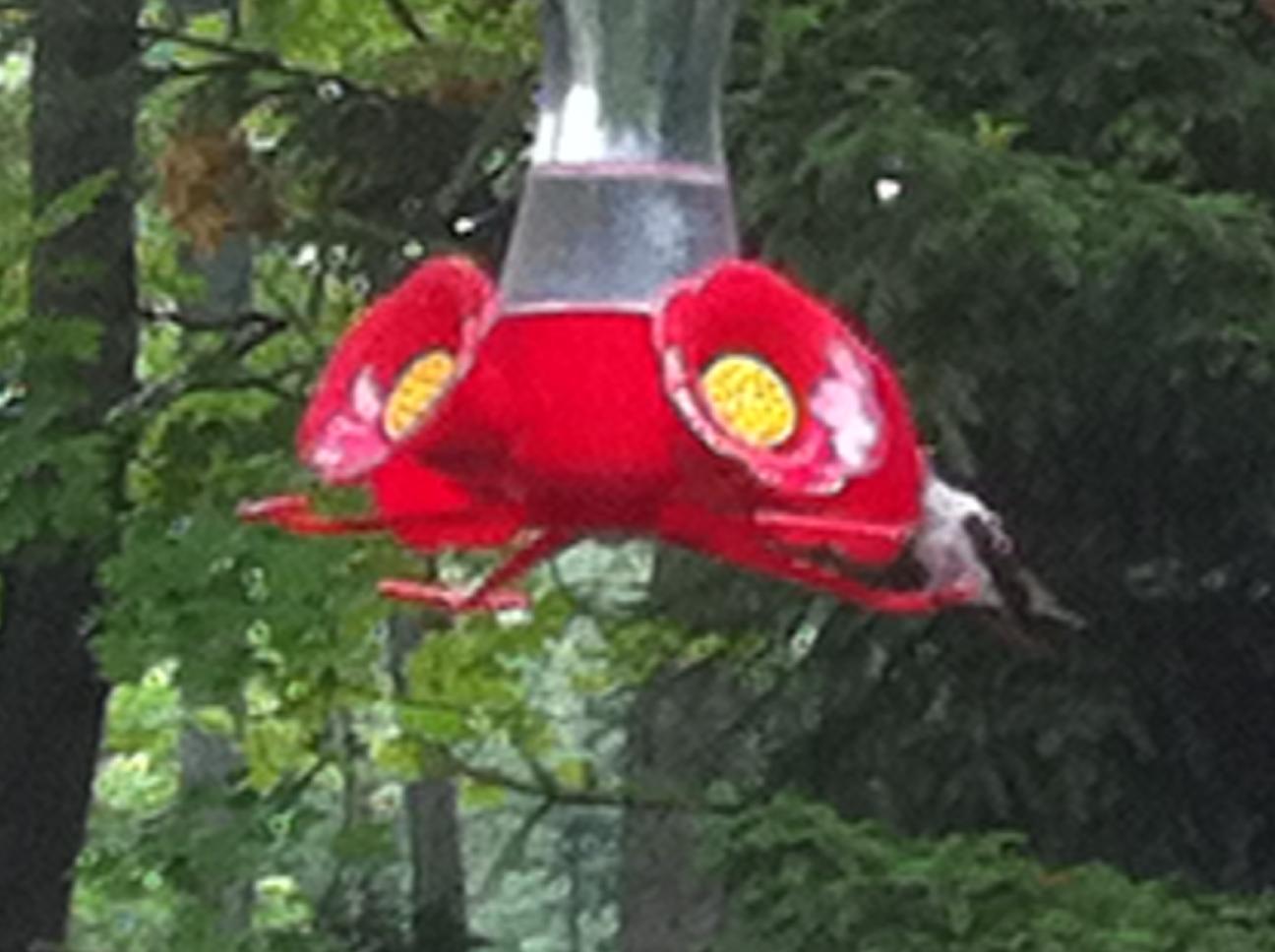
on August 11, 2011 at 12:40:39 PM by MargueriteUrban
Among the several hummingbirds darting around our feeders this summer is one
that is noticeably different--back and breast are very light with some dark
mottling, wings are dark and some dark in the tail. Apologies for poor quality
of photo. photo
Bonaparte's Gull
Posted
on August 11, 2011 at 11:46:52 AM by Barbara
Taylor
This morning at the Bracebridge Ponds we found a Bonaparte's Gull in cell 4 as
well as seven Hooded Mergansers, nine Blue-winged Teal, and a few Wood Ducks
and Mallards. Many Swallows (mostly Barn) were swooping low across the water
picking off insects. Four Green Herons were seen in the area too. Ponds
Map
Re(1): All white
bird?
Posted
on August 16, 2011 at 08:51:10 AM by GayleCarlyle
It could have been a great egret. We saw an all white large bird in a pond
south of Washago a few years ago. I thought at first it was an albino GBH but
it turned out to be a great egret.
Apparently there a number of them nesting in central Ontario.
All white bird?
Posted
on August 11, 2011 at 07:10:21 AM by BrendaLaking
At 6:30 am I saw an all white bird flying across the north end of Fairy Lake in
Huntsville along Hwy 60 from the burnt out condos area towards Kawartha Dairy.
It was as large as a large gull, but had a more deliberate straight line of
flight. The neck did not stick out, but there were either long feathers or long
legs trailing out behind it. Albino heron, egret, tropicbird?? My back is out
and I can't chase it down. It may have landed in one of the creeks feeding into
the north end of the lake quite near town.
Water Snake Mystery
Posted
on August 5, 2011 at 08:07:56 PM by George
Bryant
Our lake is full of bass—Small-mouth, Large-mouth, Rock+ Sunfish and Perch.
These fish predate minnows which is why we have no minnow species in the lake.
Weakened minnows form the chief diet of water snakes and this lack of minnows
explained why, to my mind we see a Water Snake only about once a year. That,
plus possible harassment by cottagers.
Today I found a fresh shed 2’ Water Snake skin under our concrete dock. I also
found 2’ skins on July 10 and again July 11 at the same spot. (I check it
daily.) Snakes shed their skins 4-8 times a year so that makes at least three
Water Snakes here. But we have seen none so far this year. Where are they?
I am now conjecturing that our Water Snakes may be primarily nocturnal during
this summer, staying under rocks during hot days. They could also be
aestivating (summer hibernation) like some of our turtle species.
Sandhill Cranes
Posted
on August 2, 2011 at 10:13:56 AM by Terry
& Marion Whittam
Two Sandhill cranes have been feeding for the last week in the field just east
off McArthur sideroad south of Coopers Falls road. Approximately 8k east of
Washago. Cheers Terry
Fisher family
Posted
on August 1, 2011 at 10:29:33 PM by Barbara
Taylor
Late this afternoon a family of Fishers went running through our back yard. The
local mob of Crows alerted us to them with their constant loud cawing. This is
the first time we've seen Fishers in the neighbourhood - appeared to be one
adult with two young. (Bracebridge)
Green Heron -
Beaver Creek
Posted
on August 1, 2011 at 10:25:59 PM by Barbara
Taylor
This morning along the Covered Bridge hiking trail there was a Green Heron near
the foot bridge that had been washed out in spring floods. The bridge has since
been fixed. Nothing else of note except an Eastern Bluebird perched in a dead
tree near the Moreland Cres. end of the trail. (Bracebridge)
Re(3): Caspian
Terns--Staging, Migrating or Foraging?
Posted
on August 15, 2011 at 10:20:39 PM by Doug
Smith
Caspian terns are frequent visitors to Port Carling in July and August, using
the Indian River for fishing.
Re(3): Caspian
Terns--Staging, Migrating or Foraging?
Posted
on August 4, 2011 at 09:20:52 AM by janice house
I have seen them at Skeleton Lake over the past several summers
Re(2): Caspian Terns--Staging,
Migrating or Foraging?
Posted
on August 2, 2011 at 07:14:35 AM by DebbieAdams
I saw one yesterday evening while dining at the Boathouse at Taboo. (mouth of
Hoc Roc River on Lake Muskoka.) The birds' aerial display provided quite a good
floor show, which made up for the food and service.
Re(2): Caspian
Terns--Staging, Migrating or Foraging?
Posted
on August 9, 2011 at 07:38:35 PM by george
bryant
I've seen no subsequent CATE here.
Ron Pittaway has directed me to his note in Ontario Birds. Use of garbage dump
and possible migration route of Caspian Tern in central Ontario 5(1): 35-36,
1987.
Based on many observations in the 1980s, the article describes a narrow
migration corridor in summer from Lake Simcoe to Lake Ontario with few birds
seen east and west of the corridor. Ron also saw Caspians resting with
Ring-billed Gulls at the Lindsay dump adjacent to Sturgeon Lake at the eastern
edge of the route.
I suspect the South Watcher colony has grown since the 1980's, so our birds may
now be foragers
Re(1): Caspian
Terns--Staging, Migrating or Foraging?
Posted
on August 1, 2011 at 06:14:07 PM by Al
Sinclair
Caspian Terns can be seen on Sparrow Lake all summer, also Gravenhurst Bay,
Moon river Bala, Hardy lake, as far inland from Georgian Bay as Hwy 11. My
assumption is that they forage inland up the Severn and Moon Rivers on a
regular basis throughout the breeding season. During the atlas we had many
records in southern Muskoka but all were assumed to be birds from the Georgian
Bay colony. Are they non-breeding birds? Maybe.
Caspian
Terns--Staging, Migrating or Foraging?
Posted
on July 31, 2011 at 10:50:27 AM by George
Bryant
July 30 Two Caspian Terns called and caught fish on our lake near Gravenhurst.
This is an August tradition which I had always assumed was early migration from
Georgian Bay to lower Great Lakes with staging in Lake Simcoe. However, the
Breeding Bird Atlas says they forage from their Muskoka breeding colony, South
Watcher Island as far as Matchedash Bay (40 kms). We are equidistant but
inland. Given that migration elsewhere is in September, I now wonder whether
our birds are early migrants or distant foragers. Does anyone see them on Lake
Muskoka in July.
update on
Hummingbird nest
Posted
on July 31, 2011 at 08:46:34 AM by ann hansen
Just an update on the humming bird nest at our cottage on Spence Lake (Muskoka
Falls). The babies hatched a couple of weeks ago. At first we couldn't see any
movement at the nest, then last weekend, could see the odd lift of a wing or a
head, yesterday they were quite active. Clearly saw one baby poking its head up
above the rim of the nest, stretching out wings. They are very tiny, very
beatiful. Their feathers are coming in now. I sure hope we are around to see
them before they fledge.
Brown Thrasher
Posted
on July 29, 2011 at 01:36:58 PM by tedthevideoman
We have been seeing a Brown Thrasher on and off since June.
Today our Thrasher appeared with 2 fully grown young and was feeding them with
worms and such from our garden...hope to post a picture soon!
120 Meadow Heights BB
Re(1): Bog Copper,
Bala
Posted
on July 30, 2011 at 01:07:38 PM by rick
stronks
We have records in Algonquin Park for Bog Coppers in August (I think our record
late date is August 14).
Bog Copper, Bala
Posted
on July 27, 2011 at 06:31:48 PM by Eleanor
Kee Wellman
I saw a Bog Copper flying this morning. Is this late for the species?
Re(2): Baby loon
and parents!
Posted
on July 26, 2011 at 06:26:21 PM by Terry
& Marion Whittam
Hi George, I checked a number of my other shots and the bill is definitely
black. Interesting that in many of my shots the upper bill does reflect a lot
of light so it looks lighter. That loon was also diving at the time so the bill
was wet. I'll take a closer look next time I head out to check on them. Cheers
Terry
Re(1): Baby loon
and parents!
Posted
on July 26, 2011 at 06:03:16 PM by George
Bryant
If the adult loon on the right were removed, any reasonable birder would know
you had a Yellow-billed Loon.
I assume the yellow bill is an artifact of the sunlight and bill angle, looking
black in all other views.
Interesting comparison.
Baby loon and
parents!
Posted
on July 25, 2011 at 06:52:16 PM by Terry
& Marion Whittam
Our little loon seems well on its way. Mom and dad have moved it to a quiet
area of the lake! Hopefully there is enough fish to feed all! Cheers Terry
Baby
loon and parents on guard!
Ultronia Underwing
Moth - photo
Posted
on July 25, 2011 at 10:55:53 AM by Barbara
Taylor
This colourful moth was at our porch light last night. (Bracebridge)
8857 - Catocala ultronia - Ultronia Underwing Moth photo
Here's a good reference for Underwing Moths that can be found in Ontario: http://www.silkmoths.bizland.com/catOntario.htm
Re(2): Green Herons
Posted
on July 27, 2011 at 06:33:51 PM by Eleanor
Kee Wellman
I took a look Tuesday morning and did see one bird. I think it was a juvenile.
It was partially obstructed by cattails.
Not an easy place to photograph them!
Re(2): Green Herons
Posted
on July 24, 2011 at 06:50:32 PM by Terry
& Marion Whittam
Very very nice! Great capture! Well done! Cheers Terry
Re(1): Green Herons
Posted
on July 24, 2011 at 03:26:27 PM by J.
Gardner
Jim took this photo of a Green Heron on Friday. Believe it or not, this picture
was taken at a pond beside Walmart and behind MacDonalds, in the busiest
section of Parry Sound. June Gardner photo
Green Herons
Posted
on July 23, 2011 at 11:16:24 AM by Barbara
Taylor
This morning at the Bracebridge Ponds there were at least eight Green Herons -
four juveniles, two adults, and another two that were too well hidden to tell.
They may have been from different families since only one young bird flew up
from west of cell 4 to follow an adult heading towards Kerr Park. We didn't
check the small pond next to the Kerr Park parking lot, but that has been a
favourite hunting ground for the Green Herons in past years. The family of
Virginia Rails was still in the small strip of marsh east of cell 4, but they
stayed out of sight and we could only hear their calls. Ponds
Map (north at top, west at left)
Whipoorwill in
Vankoughnet!
Posted
on July 23, 2011 at 06:47:38 AM by FrancesGualtieri
At last...I heard a whipoorwill last night...for the first time in many, many
years.
Re(1): Beware
Poachers
Posted
on August 2, 2011 at 12:00:51 PM by Barbara
Taylor
I try to monitor the board on a regular basis. If there is ever an issue with
someone's post being too specific about a location for a rare or threatened
species, then I can edit out that part. In this case, I didn't think just the name
of a road would be a problem. Perhaps the knowledge that snakes may be on the
road at night might actually save a few from being run over. The Torrance
Barrens is well advertised as a Dark Sky Reserve.
At any time if you wish to bring something to my attention, please send me an
email: muskoka_birder@hotmail.com
Re(1): Beware
Poachers
Posted
on July 26, 2011 at 07:01:39 PM by diannawolfe
I agree with Alex. We should be very aware of what we post and how the
information may be used. This is especially true for sightings of Species at
Risk reptiles. Some of these species exhibit site fidelity to the locations
where we see them and are easily caught. If we include location information in
our posts, we are potentially unknowingly providing valuable information to
nefarious individuals intent on poaching reptiles. Sadly, I have seen reptile
poachers at work, while driving the late-night roads of Arizona. It does
happen.
For the sake of our cold-blooded friends, please let's be careful.
Beware Poachers
Posted
on July 25, 2011 at 09:39:54 AM by Alex
Mills
I love visiting the barrens and one of the attractions is the herp variety.
However, reptile poaching is a serious problem everywhere, and the less
information that well meaning naturalists give to the
"herpetoculture" community, the better.
Barbara, I wonder if the nature board should have a policy?
And George, I am not chastizing you! (I have posted with regret in the past).
Night run on the
barrens
Posted
on July 21, 2011 at 11:36:32 PM by George
Bryant
Sid Daniels and I did a night run on the Torrance Barrens Muskoka Road 13 from
9 to 11 p.m. to-night. This is herpetelogical talk for driving roads in search
of mainly snakes. It has to be a hot day and evening so asphalt warms up and
attracts snakes. We observed two Massasaugas (one perhaps the largest I've ever
seen), 1 Milk, 1 Dekay's and 1 Ribbon-Total five snakes. We heard only one
Whip-poor-will and one Nighthawk, whereas a month ago I heard dozens of Whips
and several Nighthawks. Only mammal noted was one Raccoon. As always there was
no traffic.
Night runs are popular in Texas and Arizona, this is the only place I know of
where it is productive in Ontario.
Re(2): New moth for
my list
Posted
on July 22, 2011 at 09:16:41 AM by Al
Sinclair
Right, forgot about Ypsilanti Michigan. Pronounced ip sil anti I think.
Re(1): New moth for
my list
Posted
on July 21, 2011 at 11:28:35 PM by george
bryant
Nice moth.
As far as I know nothing is silent in scientific names--which makes it easy to
pronouce them. I suppose y has to become i. The other stock answer is that
nobody knows how the Romans pronounced words so you can say anything and may be
right.
New moth for my
list
Posted
on July 20, 2011 at 04:00:11 PM by Al
Sinclair
Photographed this little guy Monday, nicely colored, new to my Muskoka list but
apparently common across Canada from BC to Ontario. Food plant listed as
snowberry, willow, and honeysuckle. This is a small moth, one of the micros,
compare its size to the wood grain in the photo. Anybody know how to pronounce
Ypsolopha? Y silent?
2371 - Canary Ypsolopha - Ypsolopha canariella photo
Insects - photos
Posted
on July 20, 2011 at 11:14:08 AM by Barbara
Taylor
Here are a few insects I've found recently in Bracebridge.
Round-headed Apple Tree Borer (Saperda candida) -- Family Cerambycidae
(Long-horned Beetles)
Adults feed on foliage, but the larvae attack healthy as well as weakened fruit
trees. While Malus (apple) seems to be their favourite, they will also attack
other trees such as Amelanchier, Crataegus, and Prunus. photo
Klamathweed Beetle (Chrysolina quadrigemina or C.
hyperici) -- Family Chrysomelidae (Leaf Beetles)
I have noticed these small shiny beetles in past years, but didn't know what
they were. My best clue was that they were only feeding on St. John's Wort
plants (aka Klamathweed). The plant is indigenous to Europe, and although known
to have some medicinal benefits, it is considered a noxious weed here since it
is poisonous to grazing livestock. The two species of beetles were introduced
to North America to help control the weed. Apparently you need to examine the
beetle's genitalia to tell them apart...right. photo
Green Lacewing sp. -- Family Chrysopidae (Green
Lacewings)
These are "good bugs" to have around. Larval lacewings are sometimes
called Aphid Lions since they feed on aphids, as well as many other soft-bodied
garden pests. photo
Whitespotted Sawyer (Monochamus scutellatus) -- Family
Cerambycidae (Long-horned Beetles)
This is a borer commonly found in dead or dying conifers, especially pines and
firs. photo
Re(1): Mom and baby
loon!
Posted on
July 20, 2011 at 01:47:29 PM by Terry
& Marion Whittam
Yesterday, Tuesday I received a call from a neighbour who found a dead loon
chick about 500m from the original loon nest on another island at the lake. Last
evening I enlisted about 20 cottagers to report any loon and hopefully baby
loon sightings. Talk about "citizen science" at work. Finally today
about 1:30pm I received a report of 1 adult with baby in tow. Looks like both
eggs hatched and 1 survived. Keeping our fingers crossed! Cheers Terry
Mom and baby loon!
Posted
on July 18, 2011 at 06:25:35 PM by Terry
& Marion Whittam
I checked the loon nest on Sunday and both eggs seemed to be there! I did not
get too close even though no adults were around. Today about 5PM a neighbor
sent me this picture of mom and baby loon. 10km east of Washago. Cheers Terry
Mom and
baby loon!
Re(1): Nighthawk
Posted
on July 20, 2011 at 03:30:26 PM by Dawn
Sherman
I saw three nighthawks above the train station last night. (Main Street West in
Huntsville)
Nighthawk
Posted on
July 17, 2011 at 05:05:26 PM by Terry
& Marion Whittam
Finally heard my first Nighthawk of the year last night at sunset. I tried to
see it but could only hear it calling. Its just great to still hear them in
Muskoka! 10km east of Washago. Cheers Terry
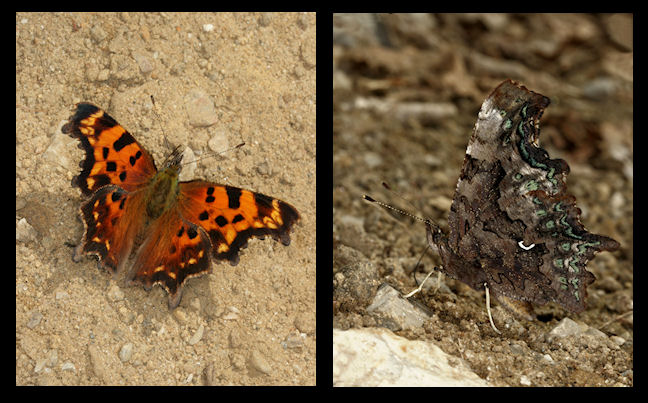
Green Comma...first
this year...photo
Posted
on July 17, 2011 at 04:58:32 PM by Al
Sinclair
We had a Green Comma in our yard at noon today, took these photos. Very
attractive butterfly! Only one brood, individuals emerging now fly until fall,
overwinter and breed the next generation in the spring of next year. Rather
uncommon here I would say, like conifer forests with their food plants alder or
poplars mixed in.
4423 - Polygonia faunus - Green Comma photo
Yellowlegs and
Virginia Rails
Posted
on July 16, 2011 at 11:53:13 AM by Barbara
Taylor
This morning at the Bracebridge Ponds there was a family of Virginia Rails in
the small marshy area east of cell 4 (two adults with three young). One adult
Green Heron flew low over cell 4 heading towards the large flooded area to the
west. Two Lesser Yellowlegs were in the south-east corner of cell 1 which was
about the only place with a bit of muddy shoreline. The water level is still
high in all cells. Ponds
Map (north at top, west at left)
Re(2): Chiggers
come to Muskoka
Posted
on July 18, 2011 at 08:51:31 AM by GayleCarlyle
A few years ago we were picking blueberries at the Torrance Barrens and my back
was really aching so I lay down in the soft moss for a while to rest.
A couple of days later, I developed about 4 or 5 extremely itchy welts in the
crook of my arm and my groin area. Turned out it was chiggers.
And I learned the hard way about scratching the welts they leave on the skin.
It took over a month to heal.
So be warned!
Re(1): Chiggers
come to Muskoka
Posted
on July 16, 2011 at 03:13:12 PM by Barbara
Taylor
Having never experienced a Chiggers attack, I decided to search for some
information about them. Now that I know more, I sure hope the Muskoka winters
will kill them so they can't take hold here! Black Flies and Deer Flies are bad
enough...and at least you can see them!
Here's a good reference about Chiggers:
http://mdc.mo.gov/discover-nature/avoid-outdoor-pests/chiggers
Chiggers come to
Muskoka
Posted
on July 15, 2011 at 10:38:27 PM by George
bryant
I was out on Wednesday chasing insects wearing long pants and boots and now
believe I have a dose of chiggers, a creature with which I have had a long
familiarity. The bites are characterized by extreme itchiness but most
significantly occur in areas where no respecting arthropod should tread (such
as around your waistline or farther south!)
Chiggers have been known from south-western Ontario (Pelee Island) for decades.
I heard recently they are now in High Park, Toronto. This hot weather has
probably brought them out. Avoid grassy pastures with livestock.
Broad-winged Hawk -
photo
Posted
on July 15, 2011 at 09:33:04 PM by Barbara
Taylor
This morning a Broad-winged Hawk was perched in a pine tree overlooking our
neighbour's garden, but then decided to fly down to an arbor for a closer look.
I managed to grab a couple shots before some Blue Jays convinced it to leave. (Bracebridge)
photo1
photo2
Re(1): Red Eyed
Vireo's vs Blue Jays
Posted on
July 14, 2011 at 03:18:25 PM by Al
Sinclair
One year we observed a Blue Jay removing recently hatched young from a
Blue-headed Vireo nest. Their presence is not appreciated by small songbirds.
Red Eyed Vireo's vs
Blue Jays
Posted
on July 14, 2011 at 08:58:42 AM by janice house
Last Sunday while sitting on the dock at the cottage (Skeleton Lake Rd 3) I
heard what sounded like alarm calls from several vireo's. They were in the top
of a white birch tree and then I spotted the blue jay. One vireo took a dive at
the jay and sent it packing. Several minutes later it chased the flock of blue
jays out of a tree a little further away. I did a bit of reading and the
vireo's may have been guarding a second brood.
Chimney Swifts
Posted
on July 12, 2011 at 03:34:33 PM by janice house
yesterday at noon at least 5 swifts were flying above the intersection of
Manitoba St & Taylor Rd
White Admiral
feeding on sap
Posted
on July 12, 2011 at 10:36:47 AM by Al
Sinclair
For a couple of weeks White Admirals, as many as 4 at a time, have been feeding
at sapsucker holes on a European Mountain Ash in our yard.
4522 - White Admiral - Limenitis arthemis arthemis photo
Young buck in
town...
Posted
on July 12, 2011 at 10:08:42 AM by Barbara
Taylor
I put out some birdseed on the feeder hoping to attract the male Cardinal with
his fledgling...but all I got was this young buck.
This is probably the same deer we saw earlier in the year when his antlers were
just starting to bud. Guess he had to wait until his favourite snacks had
regrown after his previous visits. He seems to prefer our Purple Leaf
Sandcherry shrub, Sedum spectabile, and tender green leaved hostas. The
Hydrangea shrub is also looking a bit "lopsided" from his nibbling...the
deer have never eaten that one before. (Bracebridge) photo1
photo2
Loon nest!
Posted
on July 11, 2011 at 01:40:05 PM by Terry
& Marion Whittam
A neighbour called me on the weekend to report that their grandchildren had
found 2 eggs on an island at the lake. After searching the shoreline I spotted
these 2 eggs on a shallow nest right at the water line. It was a warm day and
no loons were around. I returned in the evening keeping my distance and spotted
one of the loons on the nest. Seems very late i the year but lets hope at least
1 hatches. 10k east of Washago. Cheers Terry
Loon nest
Harvester
Butterflies are flying
Posted
on July 9, 2011 at 01:35:59 PM by Al
Sinclair
On Friday Margo Holt found a Harvester in Muskoka on Black River Rd near
Victoria Bridge. Our only carnivorous butterfly. Photo on The Simcoe Board http://www.boards2go.com/boards/board.cgi?&user=simcoenatureboard
Bracebridge Ponds
Posted
on July 9, 2011 at 01:08:56 PM by Barbara
Taylor
At the Bracebridge Ponds this morning we found three adult Green Herons in the
flooded area west of cell 4, but no sign of any fledglings yet. A Woodcock was
on the trail near the NW corner of cell 4. An Indigo Bunting was singing near
the SW corner of cell 4. A Hooded Merganser had five young with her in cell 3. There
were several families of Wood Ducks and Mallards in cell 2. Ponds
Map (north at top, west at left)
Re(2): Northern
Black Widow Spider
Posted
on July 21, 2011 at 11:41:57 PM by George
Bryant
This is what Tom Mason of the TO Zoo told me last year re the Black Widow we
found near Torrance. This is certainly the northern limit for Black Widow
Hi George: What I gather is that the northern widow was a relatively common
species north of Lake Erie and up the Bruce Peninsula until the early 40's.
They suddenly seemed to disappear and were not seen until the 80's. One theory
I heard was that it was associated to the introduction of the European earwig.
Anyway about 1985 I first had a person bring me some from the Orillia area. It
turned out to be common in that region. Since then I have started getting
specimens from quite a variety of sites. I mentioned the northern limit. To the
east, Port Hope; to the west Milton. Other places are Barrie, Angus, King City,
& Orangeville. The Lake Erie region has not been overly productive but I
have heard that people find them.
Also there are many reports of Western widows (on grapes) and brown widows on
plants and in boxes of crickets. Southern widows have shown up in equipment but
are much less common.
Re(1): Northern
Black Widow Spider
Posted
on July 8, 2011 at 10:44:18 PM by Al
Sinclair
Interesting. Any photos? I have photographed one that was found near Minden,
Haliburton Co. One was found on Beausoliel Island a couple of years ago which
is in Muskoka. The one at Minden was very docile, easy to photograph. Maybe
they are more common than we know.
Northern Black
Widow Spider
Posted
on July 7, 2011 at 03:20:06 PM by diannawolfe
Rob found a large female Northern Black Widow Spider with a magnificent egg sac
while moving wood today in Kilworthy. It is our second sighting of this species
in the Gravenhurst area, the first occurring last year with George Bryant et
al. near Torrance. Both specimens were found under pieces of wood.
Apparently, the Northern Black Widow is timid, although it may bite if
disturbed. While they are considered venomous, the bites are only considered
serious for young children, the elderly, and immunocompromised adults. These
spiders are extremely uncommon in Ontario, especially in our area. Their rarity
coupled with their tendency not to bite and their relatively weak venom make
for a very low overall risk to people.
Plus, they are tremendously cool! (I say this despite being a life-long
arachnophobe.)
Re(1): Cicada
Posted
on July 8, 2011 at 03:09:45 PM by DebbieAdams
Just heard my first Cicada of the year. (July 8, 3:10pm)
Walker's Point
Cicada
Posted
on July 7, 2011 at 09:42:31 AM by GayleCarlyle
Heard my first cicada of the year yesterday afternoon here at Grant's Woods
outside of Orillia.
Black-billed
Cuckoo, Barred Owl
Posted
on July 6, 2011 at 12:24:18 PM by george
bryant
In some summers I hear a number, others none, yesterday one sang in the
afternoon at Pine Lake, Gravenhurst, first I've heard this year. We also have a
pair of Barred Owls and for the first time in my thirty years' here, one of
them hoots periodically in broad daylight nearby. (My sense is that BAOW
numbers are high in Muskoka this year. I tried to achieve my record high BAOW count
on Muskoka Road 13 at the end of April but discovered that frog sounds drowned
everything else out.)
Re(2): Yellow
Throated Vireo
Posted
on July 8, 2011 at 02:22:45 PM by george
bryant
I heard two to-day (my first for the year) at Torrance Barrens, one at the RR
crossing before the big swasp and the other right at the Highland Pond
boardwalk. Last year Jim Goltz had two at the swamp. Birdsong was excellent
this morning although I always consider July 12 as the end of it.
Re(1): Yellow
Throated Vireo
Posted
on July 5, 2011 at 01:03:37 PM by Al
Sinclair
Good one! First Muskoka report this year that I know of. Oriole and Segwun in
north end of Gravenhurst.
Yellow Throated
Vireo
Posted
on July 5, 2011 at 11:56:21 AM by DBurton
I heard a Yellow Throated Vireo singing at the corner of Oriole and Segwun
today.
Re(2): Philadelphia
Vireo ?
Posted
on July 4, 2011 at 09:21:17 AM by Al
Sinclair
In my view, most likely a Warbling. Was it singing? Philadelphia same as a
Red-eyed, Warbling song unique.
Was it in Muskoka? Philadelphia only seen here during migration (with a couple
of exceptions).
Philadelphia Vireo
?
Posted
on July 4, 2011 at 00:17:37 AM by tedthevideoman
Help with ID Is this a Philadelphia Vireo ? photo
I have several shots if this does not give you an answer!
Re(2): Annual Bala Butterfly
Count...Final Report from Ron
Posted
on July 4, 2011 at 09:37:14 AM by Al
Sinclair
Thirteenth Annual Bala Butterfly Count (2 July 2011) by Ron Stager
Eleven people participated in the 13th annual Bala butterfly count on July 2nd
which is part of the North American Butterfly Association’s (NABA) program.
Three groups identified species and counted the number of butterflies in a
variety of habitats within a 7.5 mile radius from the centre of Bala. The day,
although forecasts threatened rain, became very warm and humid towards the end
of the count.
This year the butterfly season seemed more “normal” particular in comparison to
last year that had a very “early” season. There were 29 species observed on the
count day with one new species, Striped Hairstreak, which brought the total
species seen over the thirteen counts to 56. This year, we had the return of
our usual species including Harris Checkerspot, Common Ringlet, Northern Cloudy
Wing and some of the earlier skippers, Indian and Hobomok, were present. It was
surprising that we saw no fritillaries or swallowtails in the same year
particularly given the large number of Canadian Tiger Swallowtails in Muskoka
this year.
There were eight species that had new record number of individuals or tied the
previous records with the total number of butterflies at a new record of 5,515.
Most of these were due to the new maximum of 5,154 for European Skippers which
seemed to have a late season this year along with a record number for Northern
Cloudywing. On the other hand, there were record numbers for species which
usually peak later in our season including Northern Pearly-eye, Peck’s Skipper
and Dun Skipper. Least Skipper had a new record and Cabbage White and Delaware
Skipper matched their previous records.
The butterfly species and numbers, grouped by family, were:
Cabbage White, 13;
Bog Copper, 8; Banded Hairstreak, 1; Striped Hairstreak, 3; Azure, 3
Silvery Checkerspot, 1; Harris’ Checkerspot, 9; Northern Crescent, 17;
QuestionMark, 1; Eastern Comma 3; Mourning Cloak, 4; White Admiral, 70;
Viceroy, 3; Northern Pearly-eye, 17; Eyed Brown, 24; Little Wood Satyr, 3;
Common Ringlet, 62; Monarch, 12 ( plus 5 caterpillars)
Northern Cloudywing,8; Least Skipper, 4; European Skipper, 5154; Indian
Skipper, 2; Peck's Skipper, 41; Tawny-edged Skipper,3; Long Dash, 15; Northern
Broken-dash,3; Delaware Skipper, 1; Hobomok Skipper, 19; Dun Skipper, 20
I would like to thank the participants in general and Al Sinclair and Rick
Snider, in particular, for leading groups.
Participant List:
Al Fry, Al Sinclair, Cyril Fry, Erik Stager, Ernie Giles, George Bryant, Janice
House, JoAnne Agnew, Stephanie Lehman, Rick Snider, Ron Stager
Re(1): Annual Bala
Butterfly Count...species list
Posted
on July 3, 2011 at 02:13:41 PM by Al
Sinclair
WHITES
Cabbage White
COPPERS
Bog Copper
HAIRSTREAKS
Banded Hairstreak
Striped Hairstreak
BLUES
Summer Azure
TRUE BRUSH-FOOTS
Silvery Checkerspot
Harris' Checkerspot
Northern Crescent
Question Mark
Eastern Comma
Mourning Cloak
ADMIRALS AND RELATIVES
White Admiral
Viceroy
SATYRS
Northern Pearly-eye
Eyed Brown
Little Wood-Satyr
Common Ringlet
MONARCHS
Monarch
SPREAD-WING SKIPPERS
Northern Cloudywing
GRASS SKIPPERS
Least Skipper
European Skipper
Indian Skipper
Peck's Skipper
Tawny-edged Skipper
Long Dash
Northern Broken-Dash
Delaware Skipper
Hobomok Skipper
Dun Skipper
-------- STATISTICS --------
Species seen - 29
Re(1): Annual Bala
Butterfly Count...more photos
Posted
on July 5, 2011 at 01:17:04 PM by Al
Sinclair
More photos taken on the count by Rick Snider. Striped Hairstreak is my
favorite, a real beauty.
http://www.acdseeonline.com/album/Rick+Snider/119733/thumbnails/
Annual Bala
Butterfly Count...photos
Posted
on July 3, 2011 at 07:58:25 AM by Al
Sinclair
Great day! Numbers were good, 29 species, 11 counters in 3 groups. Highlights:
Delaware Skipper, Striped Hairstreak, Banded Hairstreak, Least Skipper,
Question Mark. Full species list later. BOG COPPER - DELAWARE SKIPPER -
LEAST SKIPPER photo
Hummingbird nest
Posted
on July 2, 2011 at 10:45:09 PM by ann hansen
This evening while out at the cottage on Spence Lake (Muskoka River), managed
to spot a hummingbird nest in a tree just off the deck. Momma hummingbird was
flitting about the tree and sitting on her nest. No sign of babies yet.
MFN Butterfly Count
Saturday
Posted
on July 1, 2011 at 11:39:28 AM by Al
Sinclair
Here is the info from the Muskoka Field Naturalists newsletter. Non-members are
welcome, nets not required, most are identified with binos. If raining tomorrow
email before 8:30 to see if it is postponed until Sunday.
JULY 2, Saturday (Long Weekend) Rain/wind date JULY 3, Sunday
The 13th Annual BALA BUTTERFLY COUNT led by Ron Stager and Al Sinclair.
Meet at 9:30 a.m. at the Ragged Rapids Hydro Parking Lot. Take Highway 38 from
Bala, roughly 5 km to the Ragged Rapids Road. Make a right hand turn and
following the Ragged Rapids Road to the hydro parking lot, keeping left all the
way.
Bring lunch, spare nets will be available.
After initial introduction and ID of butterflies, the group will split up for
different routes, reconvening at Jaspen Park at 3:30 p.m.
If it is raining heavily, or the wind is strong, postponement to Sunday is a
possibility.
If in doubt call Ron Stager or Al Sinclair (numbers in your membership list).
A $4.00 donation is requested by the North American Butterfly Association
(NABA) to defray publication costs of the results.