Muskoka Bird Board - Archived Reports from July – September 2010Return to the Index of Archived Reports
Go to the Muskoka Bird Board
Chickadee migration
Posted
on September 30, 2010 at 08:52:16 PM by Barbara Taylor
Yesterday afternoon there was a flock of about 40 Chickadees gathered together
at the south end of Browning Island on Lake Muskoka. They made a few tentative
flights out over the water but kept returning to the tall pines along the
shoreline. I'm not sure if it was the south breeze that made them hesitate or
if they decided to find a shorter stretch of open water to make their crossing.
Later we saw several small flocks of Blue Jays "island hopping" as
they headed south over Lake Muskoka.
Woodcock - Muldrew Lake
Posted
on September 30, 2010 at 10:07:24 AM by Kip
Daynard
Last week, Tuesday evening I believe, at dusk I was standing in our screened in
porch when a Woodcock fluttered over the lawn silhouetted against the fading
light.
Yesterday, I heard a late Black-and-White Warbler singing in our yard.
Interesting fall warbler photo on
the Simcoe Board
Posted
on September 26, 2010 at 08:46:15 PM by Al
Sinclair
Check out the replies to the post of this good photo of a "confusing fall
warbler" on the Simcoe Bird Board.
http://www.boards2go.com/boards/board.cgi?action=read&id=1285297719&user=simcoenatureboard
Re(3): Hummingbird!
Posted
on September 27, 2010 at 02:43:51 PM by Wilf
Yusek
Just had a female Hummer at my feeder a few minutes ago, suspect it is a migrant
as I haven't seen one here for about a week.
Re(2): Hummingbird!
Posted
on September 27, 2010 at 10:30:10 AM by Doug
Smith
There was a female (or immature) hummer at our impatiens yesterday morning, the
26th, making this our latest fall sighting by more than two weeks over any
previous sightings here. We are approx. 10 km east of Bracebridge.
Re(1): Hummingbird!
Posted
on September 27, 2010 at 09:17:44 AM by GayleCarlyle
Wow, I was wondering if all the hummers are gone but I guess not.
I have left our feeder up later this year just in case we got a last minute
visitor but haven't seen anything yet.
I'll give it another week.
We live about 10km west of Terry & Marion on the Green River in Washago.
Hummingbird!
Posted
on September 26, 2010 at 05:43:13 PM by Terry
& Marion whittam
I noticed that our hummingbird feeder went down over the past week. On Saturday
Sept 25th I saw 1 last female at the feeder just before noon. Nothing since.
10km east of Washago! Cheers Terry
Re(1): Orange-crowned Warbler
Posted
on September 25, 2010 at 05:25:06 PM by Eleanor
Kee Wellman
In Bala I had Yellow-rumps, Black-throated Greens, Nashvilles, Palm and never
have had an Orange-crowned that I know of.
White-throated Sparrows along with the chipping and songs. At least one
Blue-headed Vireo, a phoebe for a few days and a Brown Creeper(or 2) put on a
great show. Lots of both kinglets. The vireo found a katydid so there are still
lots of insects in those leaves they all keep looking at so carefully.
Orange-crowned Warbler
Posted
on September 25, 2010 at 10:09:59 AM by Barbara Taylor
Most of the Warblers have already headed south, but this morning we had a small
mixed flock feeding in our birch trees. There were several Yellow-rumped
Warblers, a few Black-throated Green, Nashville, a Bay-breasted, and an
Orange-crowned. (Bracebridge)
Huntsville Nature Club meeting on
Sept.. 27th.
Posted
on September 25, 2010 at 08:32:47 AM by rick
stronks
At the next Huntsville Nature Club meeting on Monday, September 27, Barbara
Burton, a local club member, will speak on Blooming Utah by Canoe and Llama.
This slide talk will feature the natural beauty of Utah in the spring, with its
amazing sandstone features and lovely cacti and wildflowers in bloom. It will
focus on a canoe journey down the Green River to the Colorado River, and an
archaeologist guided backpacking trip with llamas in Grand Gulch to see the
ancient cliff dwellings and rock art. Don’t miss this opportunity to see a very
unique area of the world.
The Huntsville Nature Club meets on the last Monday of every month at Club 55
in the Town Hall at 7 p.m. and guests are always welcome - a voluntary $2.00
donation is appreciated. For more information regarding the Huntsville Nature
Club, contact Ken Morrison (789-1407) or Rick Stronks (635-3315).
MFN outing to Big Chute canceled
Posted
on September 25, 2010 at 08:03:38 AM by Al
Sinclair
The Muskoka Field Naturalists canoe trip at Big Chute Saturday September 25 has
been canceled due to inclement weather.
Beaumaris Birds
Posted
on September 24, 2010 at 01:09:31 PM by MaryWillmott
Birds seen this am of note
large flock American Pipit
White- crowned Sparrow
Ruby-crowned Kinglet
White-throated Sparrow
Sharp-shinned Hawk attacking (unsuccessfully) a Sparrow
Beaumaris Birds
Posted
on September 24, 2010 at 10:13:37 AM by MaryWillmott
On Wednesday on my hike around Beaumaris Birds seen
Eastern Phoebe
Gray Catbird
White Throated Sparrows
Song Sparrows
Chipping Sparrows
Purple Finches
American Goldfinch
6 Common Mergansers
Large flock of Robins (many young in the group)
Wild Turkeys
Re(1): Phoebe
Posted
on September 24, 2010 at 12:21:40 PM by Alex
Mills
It does seem like it's getting late for a flycatcher, but I can often still
find a Phoebe at thanksgiving. Unlike most flycatchers, which fly to the
tropics for the winter, most phoebes go only to the southern US, and they
happily eat fruit during tough times.
Phoebe
Posted
on September 24, 2010 at 09:27:27 AM by GayleCarlyle
Yesterday we had a visit from a phoebe, happily eating insects around our front
yard.
It has been around for a while, not every day, but often.
Seems a bit late for them to still be around.
Does anyone know when the last fall date is to see one?
We're in Washago by the way.
Re(1): Algonquin Park: Carolina Wren
Posted
on September 24, 2010 at 04:59:39 PM by Ontbirds
*This report was originally posted by Rick Stronks on ONTBIRDS (September 24,
2010) and is provided here with the kind permission of the Ontario Field Ornithologists.
The Carolina Wren was seen again this morning at the Algonquin Logging
Museum behind station 3 (square log exhibit).
Directions:
Algonquin Park is three hours north of Toronto, via Highways 400, 11 and
60. Follow the signs, which start in Toronto on Highway 400 to Highway 11
and east on Highway 60. From Ottawa, take Highway 17 to Renfrew, then
follow Highway 60 to the park. The Logging Museum is located at km 54.5
(near the East Gate, Whitney).
Rick Stronks
Chief Park Naturalist
Algonquin Provincial Park
Algonquin Park: Carolina Wren
Posted
on September 23, 2010 at 08:08:34 PM by Ontbirds
*This report was originally posted by Justin Peter on ONTBIRDS (3:08 p.m.,
September 23, 2010) and is provided here with the kind permission of the Ontario Field Ornithologists.
Hi Ontbirders,
A Carolina Wren is at the Algonquin Logging Museum right now. It was originally
found by Lev Frid, who happened to be working at the museum today. It was
successfully re-found by a bunch of us and is still there at this time. It has
been hanging around in the Red Pine forest near Posts 5 and 6. It is singing
intermittently. This is a new species for Algonquin Park!
Good birding!
Justin
Park Naturalist / Interprète-naturaliste
Visitor Centre / Centre d'accueil
Algonquin Provincial Park / Parc provincial Algonquin
Ontario, Canada
613-637-2828 x. 223
justin.peter@ontario.ca
www.algonquinpark.on.ca & www.sbaa.ca
www.youtube.com/FOAPAlgonquinPark
Winter Finch Forecast
Posted
on September 23, 2010 at 01:13:15 PM by Barbara Taylor
Ron Pittaway has posted his Winter Finch Forecast on Ontbirds. You can find it
here: http://mailman.hwcn.org/pipermail/ontbirds/Week-of-Mon-20100920/025247.html
Rusty Blackbirds
Posted
on September 23, 2010 at 01:00:23 PM by Barbara Taylor
Around noon today there were over 50 Rusty Blackbirds on the roadway at the
south-west corner of cell 4 at the Bracebridge Ponds. They were feeding on a
large hatch of insects (looked like small mayflies) that had gathered in that
area since it was sheltered from the wind.
Bent River Birds
Posted
on September 22, 2010 at 07:08:47 AM by janice house
A flock of american pipits have been hanging out in my brothers field, a red
shouldered hawk has been calling, turkey vultures riding the thermals, red eyed
vireo, blue headed vireo and golden crowned kinglets with the chickadees and
goldfinch's
White Peacock/hen
Posted
on September 20, 2010 at 09:06:25 PM by Shauna
We have spotted what we believe is a female peacock, in leucistic plumage, at
our cottage on Lake Vernon in Huntsville. The bird seems fairly tame and
appears to be staying close to our propery. We are concerned that this bird may
belong to someone and has escaped. If you know of anyone looking for this bird
please contact us.
great horned owls
Posted
on September 20, 2010 at 08:13:21 AM by Wayne
Bridge
Kearney: I've never seen or heard a great horned owl here before - saw-whet and
barred being the two normally seen/heard - but this morning about 1 a.m. there
was a great horned owl across the road calling to another further away. It went
on for quite a while. I went back to bed and back to sleep.
Re(1): Lagoons
Posted
on September 19, 2010 at 01:52:32 PM by Barbara Taylor
Don Bailey reports this morning there were three Rusty Blackbirds by the south
end of cell 1, and some Field Sparrows. No Coot and no Pintail. There was a
Lesser Scaup and American Wigeon in cell 1, and also several Green-winged Teal,
Blue-winged Teal, Wood Ducks, Mallards, and some Black Ducks. A Red-tailed Hawk
was perched in a tree near the Lagoon Lane entrance.
Lagoons - Coot, Pintail, Shovelers
Posted
on September 18, 2010 at 02:11:33 PM by Goodyear
This morning at the Bracebridge lagoons we had a single Coot, a female Pintail,
and two female Shovelers - all in Cell 1. Many Mallards, Blue-winged Teal, and
Wood Ducks, as well as Green-winged Teal and Black Ducks.
Re(3): Hummingbirds - seasonal
migration pattern
Posted
on September 23, 2010 at 09:48:39 AM by J.
Gardner
Our last two hummers seem to have blown away with the big winds of the 21st
September. Not seen since the morning of the 21st. Latest sighting at our place
in Hurdville.
Re(2): Hummingbirds - seasonal
migration pattern
Posted
on September 20, 2010 at 07:09:21 PM by J.
Gardner
Still have two juvenile hummers here. I left the feeder out on recommendation
of Hummingbird Project, and they still visit the feeder. Never have had them
this late as I usually take the feeders in on or around the 10th of September.
Re(1): Hummingbirds - seasonal
migration pattern
Posted
on September 19, 2010 at 05:50:52 PM by Wilf
Yusek
Have a female hummer here today not at my feeder but nectaring on my Fuschia
flowers.
Re(2): Hummingbirds - seasonal
migration pattern
Posted
on September 17, 2010 at 04:25:57 PM by Debbie Adams
We still have one lone female. As of 3:30pm today, she was busy at the feeder
and then sharing perching space in our birch tree with several chickadees and 2
goldfinches. This is the latest we've ever noted a Hummingbird.
(Walker's Point)
Re(1): Hummingbirds - seasonal
migration pattern
Posted
on September 17, 2010 at 12:54:37 PM by Wilf
Yusek
Yes we had one here on Sept.29/2002 at Prospect Lake, in checking my records I
also note that I had one on Sept. 23rd 2007 & 2008, same date.
Hummingbirds -
seasonal migration pattern
Posted
on September 17, 2010 at 11:49:11 AM by Barbara Taylor
I checked the Bird Board Archives to see what the usual last sighting date was
for Ruby-throated Hummingbirds. It varies from year to year, but Sept. 16 seems
to be a common "last seen" date in our area. The latest report I
found was Sept. 25, 2006 in Port Sydney. Has anyone recorded a later date than
that?
There is an interesting article by Allen Chartier about the fall migration of
hummingbirds over 22 years at the Holiday Beach Hawk Watch. The data is from
1976 to 1997 and there is a chart showing the peak migration days (see Figure
4): http://www.amazilia.net/MIHummerNet/22years.htm
Skeleton Lake Hawks
Posted
on September 17, 2010 at 07:11:32 AM by janice house
Wednesday night on Skeleton Lake Rd 3 there was a broad winged hawk sitting on
the bell wires that cross the road and a red shouldered hawk was calling from
the trees on the north west corner of the beaver pond
American Pipits
Posted
on September 14, 2010 at 01:17:15 PM by Wilf
Yusek
Saw 4 American Pipits on the 3rd fairway at Muskoka Highlands Golf course this
morning
Re(2): Migrants - N. Muldrew Lake
Posted
on September 16, 2010 at 10:01:57 AM by Kip
Daynard
Forgot to mention I had Nashville as well. Surprisingly I heard a Pine Warbler
singing yesterday afternoon along Pinetree Rd. by Loon Lake. Black-and-White
Warblers have been singing on and off here until recently. I think the
Hummingbird has now left.
We had a Fox in our backyard yesterday - it had just caught a mouse and was
eating it. A few mice have made their way into the house recently so that was a
welcome sight indeed!
Re(1): Migrants - N. Muldrew Lake
Posted
on September 15, 2010 at 05:25:44 PM by Eleanor
Kee Wellman
My list is similar to Kip's with additons of two different Blue-headed Vireos,
Red-eyed, Scarlet Tanager, Pine, Nashville and Black & White Warblers.
I haven't seen any of the several American Redstarts that were around. I have
seen at least one Brown Creeper numberous times over the last few days. My only
sightings have been during migration here.
My big one was a, heard only, Peewee! The only time I have heard one all
summer.
Migrants - N. Muldrew Lake
Posted
on September 14, 2010 at 11:57:22 AM by Kip
Daynard
A small migrant fall-out came to the big white pine outside my office window
this morning (which made getting anything done rather difficult!):
Pine Warbler
Yellow-Rumped Warbler (many)
Palm Warbler
Black-throated Green Warbler
Ruby-crowned Kinglet
White-throated Sparrow
Haven't seen Blue Jays here for a month or more but one was around this
morning. Chipping Sparrows had a very good year this year. We have at least 6
first year birds feeding in close proximity in the back yard and at least one
still in juvenile plumage. Hummingbird female was still here yesterday. Phoebe
is still here as well. We had a few goldfinches around all summer and they are
now moulting back into their winter plumage.
Three Wild Turkeys recently got in the habit of coming and drinking from a
water bowl that we'd left outside on the front step from when my sister brought
her Black Lab to visit. The resident bat still perches under the overhang of
our entrance every night as evidenced by fresh droppings daily.
Osprey - N. Muldrew Lake
Posted
on September 14, 2010 at 08:19:37 AM by Kip
Daynard
Yesterday afternoon while on a run I saw an Osprey fly up from a perch carrying
something large (a fish perhaps?) off Whippoorwill Rd. off North Muldrew Lake
Rd. First I've seen on the lake this year.
Re(1): Bracebridge Ponds - Palm
Warblers, no Redheads
Posted
on September 12, 2010 at 02:25:50 PM by Barbara Taylor
This morning we couldn't find the Redheads, but there were five Scaup along
with many Mallards, Wood Ducks, and a few Green-winged Teal and American Black
Ducks. A Merlin swooped down over the ducks a few times and then headed north
over Kerr Park. Shortly after it left, most of the ducks took off, flying
towards the south-west.
Several Yellow-rumped Warblers were hawking insects along the roadway at the
west side of cell 4 and a Lincoln's Sparrow was perched in one of the shrubs
there. A few Palm Warblers were in the shrubs to the south of cell 4, along
with a Gray Catbird and a small Flycatcher (Least?). A Northern Harrier flew
overhead towards the south. There was a small flock of White-crowned
Sparrows in the thistles and goldenrod west of cell 2. A Green Heron was at the
edge of the little frog pond in Kerr Park.
Redheads - Bracebridge Ponds
Posted
on September 11, 2010 at 01:32:38 PM by Barbara Taylor
Around noon today there were two male Redheads (non-breeding plumage) in cell
2. Two Least Sandpipers and a Greater Yellowlegs were on a small strip of muddy
shoreline near the north-west corner of cell 1. Bracebridge
Ponds map (north approx. at top and west at left)
Re(1): Gray Treefrog
Posted
on September 14, 2010 at 09:42:51 AM by GayleCarlyle
We had a garden pond put in this spring and were thrilled to have treefrogs
breed, lay eggs, and then have tadpoles hatch. Later on there were little
treefrog froglets sitting along the edge of the pond; bright green little guys.
We'll try to get some photos posted.
So maybe next spring, we'll have even more frogs at our pond!
Gray Treefrog
Posted
on September 10, 2010 at 07:24:35 PM by Barbara Taylor
This Gray Treefrog spent the afternoon on our sunny front window. photo
We usually just hear their calls so it was nice to actually see one.
(Bracebridge)
Re(2): turkeys
Posted
on September 10, 2010 at 05:24:03 PM by Wilf
Yusek
It has twice in the last couple of years, but I rarely leave them out at night,
forget once and it happens. last year as I was out getting them one bear came
out of the woods behind my neighbors place, I roared at it, it stood up and ran
back into the woods, I was only a short distance from my garage side door ready
to run in and close it.
Re(1): turkeys
Posted
on September 10, 2010 at 05:00:13 PM by Eleanor
Kee Wellman
Wilf,
Your birdfeeder looks like its seen more bears than turkeys!
turkeys
Posted
on September 10, 2010 at 04:09:43 PM by Wilf
Yusek
These 2 have been here most of the afternoon, they are eating sunflower seeds
that other birds knock to the ground from my feeders photo
Carolina Wren
Posted
on September 9, 2010 at 01:56:27 PM by ejongran
A Carolina Wren, singing loudly, visited our garden about noon today. It
explored under our canoe, then boat, and seems to have moved on. Acted more
like a mouse than a bird. (We had one winter over here for 2 consecutive
winters a few years back)
Jon Grandfield
20 Sallys Lane
Port Sydney
(Off district road 10, 3 km east on highway 11, exit 207)
Re(3): Hummingbird
Posted
on September 16, 2010 at 05:14:42 PM by J.
Gardner
September 16, left the feeder up in Hurdville on recommendation of Hummingbird
Project. Picked up another juvenile, for a total of two. Cold miserable
weather. I want to take off for Venezuela. What's wrong with these birds?
Re(2): Hummingbird
Posted
on September 15, 2010 at 03:20:00 PM by Barbara Taylor
When I haven't seen any hummingbirds for about a week, then I take down the
feeder mid-morning. I figure that way if there is still a hummingbird around,
it can fuel up after a cold night before heading south.
You can leave your feeder up as long as you'd like since it won't prevent birds
from migrating. You can also take it down whenever you'd like since they aren't
dependant on it and will just go feed somewhere else.
Re(1): Hummingbird
Posted
on September 15, 2010 at 02:17:25 PM by MikeWeiss
Im on Penetang bay.. I also have hummers at my feeder....Is it safe to keep the
feeders still up... Im thinking when you suggest to take them down we do it at
night... is that correct.. thanks
Re(6): Hummingbird
Posted
on September 13, 2010 at 03:54:33 PM by Debbie Adams
Thanks Gayle for that info. The female that is still here has been busy at the
feeder all day. I suspect she's happy to have it all to herself now that the
others have gone.
(Walker's Point)
Re(5): Hummingbird
Posted
on September 13, 2010 at 12:55:35 PM by GayleCarlyle
We still have a hummer around our place in Washago as of yesterday (didn't have
time this morning to look)
According to Cindy Cartwright with the Ontario Hummingbird Project, we should
all be leaving our feeders up as long as possible (until heavy frost) because
migrating birds that may be a little late in their travels will appreciate the
food. And it may mean the difference between life and death for the little
creatures.
So this year I'm leaving ours up until the solution starts to freeze over night.
Re(1): Hummingbird
Posted
on September 13, 2010 at 10:32:40 AM by Debbie Adams
There is a female at our feeder as I write this. The others seem to have left.
(Walker's Point)
Re(4): Hummingbird
Posted
on September 12, 2010 at 03:29:21 PM by Terry
& Marion Whittam
We still had 2 hummers fighting over the feeder today Sept 12 10km east of
Washago! Cheers Terry
Re(3): Hummingbird
Posted
on September 10, 2010 at 12:53:14 PM by Wilf
Yusek
Have a female hummer here at Prospect lake today.
Re(2): Hummingbird
Posted
on September 9, 2010 at 07:11:45 PM by Eleanor
Kee Wellman
Hummers still around my place in Bala. I saw a male this morning. There has
been one here all along. Not as many coming around as last week, though.
Re(1): Hummingbird
Posted
on September 9, 2010 at 01:14:24 PM by J.
Gardner
We seem to have only one adult female hummer left, since the other female and a
juvenile departed yesterday. The 10th of September seems to be the latest
departure date around our place in Hurdville. I usually take the feeder down
after that date to encourage the stragglers to depart.
Re(1): Hummingbird
Posted
on September 9, 2010 at 05:10:55 PM by Debbie Adams
Our Hummingbirds are still here and bulking up for the flight south. The feeder
needs refilling! (Walker's Point)
Hummingbird
Posted
on September 9, 2010 at 11:48:33 AM by Barbara Taylor
I was going to take down our hummingbird feeder since all our
"resident" hummers left a week ago. But one showed up at the feeder
this morning and is hanging around...most likely a migrating juvenile bird.
Re(2): Strange Tomato...photo
Posted
on September 9, 2010 at 00:59:03 AM by ted gardner
guess it would help to see it! photo
Re(1): Strange Tomato...photo
Posted
on September 9, 2010 at 00:57:11 AM by ted gardner
Wow...we have a strange tomatoe too! buts its different!
Strange Tomato...photo
Posted
on September 7, 2010 at 09:47:10 PM by Al
Sinclair
This morning Joan found this strange tomato on her cherry tomato plant. photo (Monarch Butterfly Chrysalis)
Bold Jumping Spider...photo
Posted
on September 7, 2010 at 09:33:32 PM by Al
Sinclair
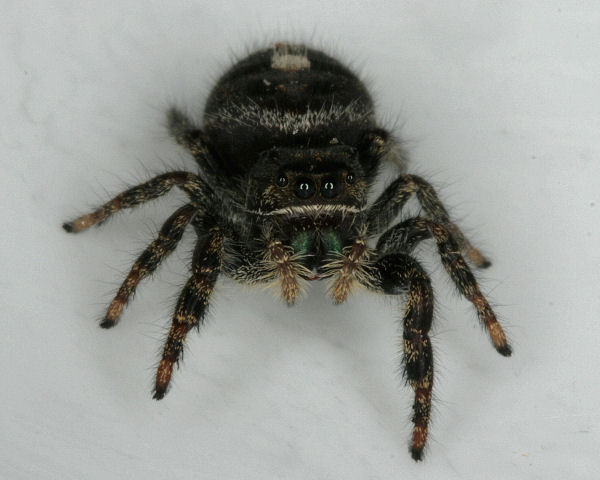
This spider arrived in Muskoka hidden in some grapes we picked on the Niagara
Peninsula last Saturday. Note the iridescent chelicerae (jaws). This little
spider has a painful bite. Bold Jumper (male) - Phidippus audax photo
Re(2): Pine Siskins?
Posted
on September 9, 2010 at 01:06:02 AM by ted gardner
Not Siskins they have finch bills...Purple young or females
Re(1): Pine Siskins?
Posted
on September 7, 2010 at 08:11:51 PM by Alex
Mills
Streaky like Pine Siskins and using a feeder like Pine Siskins, but, as you
say, no yellow. They also have a bigger look to them, with a thicker bill. How
about Purple Finches? The one on the left has the buffy wing feather edges of a
bird born this year.
Pine Siskins?
Posted
on September 7, 2010 at 06:46:17 PM by michaelhatton
What happened to the yellow? photo
A new mushroom...hard to ID
Posted
on September 6, 2010 at 06:27:56 PM by Al
Sinclair
We found this mushroom near our place on August 30, 2010. It was new to me and
I had some trouble putting it in the right genus. I initially assumed it had a
white spore print because of the white gills. It had free gills (not attached
to the stalk) and was growing on the ground so looked at amanita and lepiota
species, eventually gave up for the day.
The next day I looked again at them and noticed where the caps overlapped that
the spores were collecting and were brown, so I picked two and took them inside
for a spore print. Next day I had a good print and to me they looked buff brown
coloured and the gills were now brown. There is no mushrooms with free gills
and brown spores, gave up for the day.
Next day looked at mushrooms again and decided their shape and size was like
some Pluteus cervinus mushrooms growing nearby. Looked at this genus in
Mushrooms of North America (Phillips) and there it was Pluteus petasatus. Most
Pluteus mushrooms have pink spores. Phillips describes the spores of this
species as dull pink, notes that they grow on sawdust piles, mine were on wood
shavings. Mushrooms Demystified (Arora) describes the spore colour of petasatus
as pinkish to deep flesh colour. I have included a photo of the spores, maybe
deep flesh colour.
You can read about this mushroom at http://www.mushroomexpert.com/pluteus_petasatus.html.
Others have had trouble IDing it too. I assume it must be not that common in
eastern North America as it is not in Mushrooms of Ontario (Barron) or the
Audubon Field Guide (Lincoff).
Pluteus petasatus: photo spore print photo
redstarts
Posted
on September 6, 2010 at 10:00:14 AM by michaelhatton
Redstarts moving through - west end of Leonard Lake
Re(3): Bracebridge
Ponds - Lincoln's Sparrows
Posted
on September 6, 2010 at 12:08:17 PM by Barbara Taylor
This morning there were still lots of Sparrows and Common Yellowthroats in the
same area, but we didn't see the Le Conte's/Nelson's mystery sparrow. Instead
we were treated to two Lincoln's Sparrows perched in a dead leafless shrub at
the south-west corner of cell 2. (Google Map of sparrow locations)
I forgot to mention yesterday that we saw several Turkey Vultures soaring
southward. Today no vultures, but we had an Osprey fly overhead cell 4.
Re(2): Bracebridge Ponds
Posted
on September 5, 2010 at 10:13:53 PM by Barbara Taylor
The roadway/dike between cells 1 and 2 intersects the roadway that runs along the
north side of cell 3. The bird was a short distance west of that intersection,
on the cell 3 side of the road, not too far in from the roadway. There is an
Elderberry shrub nearby on the cell 2 side of the road. Some of the sparrows
flew into that shrub as we walked by, but they quickly moved down into the
weeds out of the wind and out of our sight.
(here's a Google map of the approximate location)
Re(3): Bracebridge Ponds
Posted
on September 6, 2010 at 03:05:00 PM by Al
Sinclair
Formal? Sort of I suppose. There is no Muskoka Rare Birds Committee. So instead
I have been keeping an informal list with some documentation but not as well
organized as it could be. A list prepared by Bob Bowles is the basis of the
list and I have added status codes and new species as they occur. I investigate
reports of rare species and decide whether they are reliable enough to be added
to the list. There are quite a few species that likely pass through during
migration like Le Conte's and Nelson's Sparrow but are not on the list because
there have been no reliable sightings that I am aware of. You can see the list
at: http://users.muskoka.com/sinclair/archives/muslst.html
Re(2): Bracebridge Ponds
Posted
on September 6, 2010 at 08:51:05 AM by Alex
Mills
Al refers to the Muskoka List. I'm wondering if there is a 'formal' list, and
if so, who keeps it?
Re(1): Bracebridge Ponds
Posted
on September 5, 2010 at 06:29:37 PM by Al
Sinclair
Either would be a new species for the Muskoka List. Could you be more precise
on the location? I might have a chance to look for it tomorrow.
Bracebridge Ponds
Posted
on September 5, 2010 at 05:20:00 PM by Barbara Taylor
At noon today there was a Hooded Merganser and a Pied-billed Grebe in cell 4. A
Green Heron was perched in a dead tree west of cell 4. Many Mallards, Wood
Ducks, and a few Blue-winged Teal were in cell 3. We didn't see any shorebirds
except for a Spotted Sandpiper. (cell 3 is mostly overgrown with thick
vegetation and no mudflats, but there is a very thin strip of shoreline along
south end of cell 1)
Several Savannah Sparrows and Common Yellowthroats were feeding in the
Smartweed along the roadway at the north side of cell 3. We got a quick look at
one sparrow that stood out from the rest - possibly a Le Conte's Sparrow or a
Nelson's Sparrow? Since we've never seen either one, and our field guides give
seemingly conflicting descriptions, we can't be sure which. (note: Nelson's
Sparrow is the newer naming for the Nelson's Sharp-tailed Sparrow - it was
renamed in the 2009 AOU 50th Supplement)
Re(3): Moths
Posted on
September 5, 2010 at 10:57:44 AM by Al
Sinclair
Sorry,I have seen Speckled Rustic but have it listed as Platyperigea multifera,
not a common moth here. I kept the previous name because Canadian Biodiversity
Information Facility (CBIF) still uses it. I assume there is disagreement on
the name change.
Re(2): Moths
Posted
on September 5, 2010 at 10:45:53 AM by Kip
Daynard
Thanks for your comments Al.
I did look at the Muskoka Moths website and noticed the images of Rosy and
Speckled Rustic there.
Unfortunately I did not end up taking any photos. I had set the camera up on a
tripod but the moths were so small in the frame it seemed pointless. In
retrospect I should have snapped at least one frame as yes after blowing them
up at least some useful detail could likely have been seen. Will do so next
time and will see if I can locate this species again.
Re(1): Moths
Posted
on September 5, 2010 at 10:28:51 AM by Al
Sinclair
Moths do vary a lot in darkness, also change as the scales wear off. I have
seen Rosy Rustic only once here, have not seen the others. Did you look at this
website: http://www.moths.castillejalabs.com/
All these are from Muskoka. Also check this one: http://mothphotographersgroup.msstate.edu/MainMenu.shtml
If you like, email your best photos to my address, take some from your closest
focus and I will blow them up on the computer. I would be interested in what
you are seeing at your location.
Moths
Posted
on September 4, 2010 at 03:51:37 PM by Kip
Daynard
I caught three moths in my garage last night in a jar.
One appears to be a typical Rosy Rustic (hydraecia micacea) http://bugguide.net/node/view/10779.
The second looks nearly identical except is quite a bit darker. Can they vary a
lot in darkness/lightness or is this likely a different species?
The third I'm really not sure of but my best guess is either:
Speckled Rustic (caradrina multifera) http://bugguide.net/node/view/77324
or Civil Rustic (caradrina montana) http://bugguide.net/node/view/204341.
I'd say it looks more like the former although my specimen appears to be
drabber than either with only a hint of dark patterning in the wings where the
guide shows zig-zag patterning and orbicular/reniform spots. It does show some
speckling mainly along the leading and terminal edges of the fore-wing, a hint
of several lines running across both wings and a biggish dark smudge roughly
where the reniform spot should be. No orbicular spot that I can make out.
Speckled Rustic appears to be more likely as Civil Rustic looks like more of a
western species although I see there have been a couple of records in Toronto
and one in Brantford. Any other suggestions?
I'd post a photo but unfortunately don't have a close-up lens so cannot obtain
a decent photograph.
Pine Grosbeak - Killarney P.P.
Posted
on September 3, 2010 at 03:23:32 PM by Kip
Daynard
A highlight of my annual canoe trip to Killarney, and a big surprise for me
this time of year, was a couple of Pine Grosbeaks seen on Aug. 24th on the
portage between Freeland and Killarney Lake.
What drew my attention initially was a flash of a bird with bright red/pink
overall with darkish wings and white wingbars. I quickly realised there were
two birds but the second was mostly gray. Unfortunately I was not carrying my
binoculars but was able to approach quite close to one of them.
I initially expected them to be White-winged Crossbills as I encounter these
pretty regularly in Killarney at this time of year (and indeed did hear some a
couple of days later giving their 'tyik tyik' in flight). However, the one I
was able to get a good look at turned out to be all wrong for WW-Crossbill. It
had a definite Grosbeak look to it being quite a bit larger than a Crossbill,
stocky in the chest and long-tailed. It was also unusual in being in a stage of
moult with a mostly plain gray breast but with a central area of pinkish-red.
As far as I could tell the head was more of a russet colour but mixed with a
bit of greenish. Its throat was a paler gray (slightly buffy?), lighter than
its breast. I didn't get a good look at its rump.
After careful consideration I feel pretty convinced these were Pine Grosbeaks.
The closest representation of this bird (photos by Brandon Holden via links to
his site) I have found is as follows although the throat looked a bit more like
the one in the 2nd image: photo1 photo2
See Brandon's photo gallery showing variability in Pine
Grosbeaks http://www.peregrineprints.com/zzzzArticle_PIGR.htm
My initial assumption was that it may have been an adult male and an immature
male. I understand that Pine Grosbeak males don't acquire their full adult
plumage until their 2nd year but can show some red in the breast. (See http://www.allaboutbirds.org/guide/Pine_Grosbeak/id).
Could this have been a juvenile still in the company of its parent?
However, a quote from Peter Pyle on the above site suggests that this may also
have been an older adult female.
He said: "It is well-known that older females can acquire male-like
plumage (as estrogen levels decline and stop masking testosterone) but there
may be other factors involved with Pine Grosbeaks. Whether the reddish color
results from molt-timing or diet-related interactions or simply that adult
females of this species more often can show red would make an excellent subject
for further study."
Based on that it seems possible that this may have been a mated pair. In
retrospect, the habitat was probably quite suitable being moist, mixed forest
near water.
The 2001-05 Ontario Breeding Bird Atlas shows only one square with possible
breeding evidence in central Ontario, and that in the vicinity of Britt, about
60kms to the south-east. I realize that seeing a pair, or even adult-juvenile
at this time of year does not perhaps constitute breeding evidence but the
possibility seemed interesting none-the-less.
Any comments would be most appreciated.
Kip
Northern Map Turtle
Posted
on September 2, 2010 at 09:11:13 PM by DonScanlan
In Bracebridge today, Thur. Sept.2, I met a man and two boys, one of them
carrying a turtle down to the water by the Entrance street bridge. They said
they had found it uptown on the street. It was a full grown Map turtle. They
released it downstream of the generating station.
Algonquin Park - Warblers, incl.
Connecticut
Posted
on September 2, 2010 at 06:22:03 PM by Ontbirds
*This report was originally posted by Lev Frid on ONTBIRDS (Sept. 2, 2010) and
is provided here with the kind permission of the Ontario Field Ornithologists.
Hello Birders,
Here in Algonquin Park, warbler migration is in full swing. Yesterday (Sept
1st), birding along the railway bed at the Mizzy Lake Trail was phenomenal.
The birds were mainly concentrated about 200 m past the locked gate on the
railway bed. The flock was enormous. I came up with 17 species, with many
individuals.
75+ BLACKBURNIAN
50+ NASHVILLE
30+ BLACK-THROATED GREEN
30+ YELLOW-RUMPED
Also handfuls of the following -
BAY-BREASTED
BLACK-THROATED BLUE
AMERICAN REDSTART
MAGNOLIA
BLACK-AND-WHITE
COMMON YELLOWTHROAT (Many still on territory)
and singles of the following -
CAPE MAY
TENNESSEE
OVENBIRD
ORANGE-CROWNED (Early)
BLACKPOLL (Rare for Park)
CONNECTICUT - One of the few park records - was associating with the
abundant Nashvilles. A juvenile, with the brown hood barely contrasting with
the olive body and yellow belly. Very brief, but excellent look!
Also present were a male SPRUCE GROUSE, a pair of GRAY JAYS, and about a
half-dozen BOREAL CHICKADEES to spice things up.
This morning Justin Peter and myself birded the railway bed, and though the
numbers were down, most of the common species were observed, as well as many
BOREAL CHICKADEES!
'Tis the season, folks, so come on up here and enjoy the birds!
Directions:
Algonquin Park is three hours north of Toronto, via Highways 400, 11 and 60.
Follow the signs, which start in Toronto on Highway 400. From Ottawa, take
Highway 17 to Renfrew, then follow Highway 60 to the park.
The Old Airfield is located along the Mew Lake Campground access road, park at
a small parking lot on the left at the beginning of the Old Railway Bike Trail
and walk around the airfield.
The Wolf Howl Pond & West Rose Lake area can be accessed by driving 4.8km
up
Arowhon Rd and then turning right onto an abandoned railway and follow 0.6km to
chain gate, park well to the side and walk in 1.5km to Wolf Howl and another
1km to West Rose.
Good Birding!
Black Bears and Big Macs
Posted
on September 1, 2010 at 08:52:37 PM by FrancesGualtieri
I read an article on black bears this summer in the Sudbury Star. I didn't
realize that they need 20,000 calories a day - the equivalent of 37 Big Macs!
And to think that instead they have to settle for grubs, berries...But they can
see in colour, so at least they can identify the Golden Arch!
Muskoka Field Naturalists - next meeting
Sept. 2 in Bracebridge
Posted
on August 31, 2010 at 05:16:48 PM by Barbara
Taylor
Please note: Meeting location September through and including January – Church
of the Latter Day Saints, corner of Cedar Lane and Taylor Road, Bracebridge.
SEPTEMBER 2, 7:30 p.m. in BRACEBRIDGE
BURROWING OWLS with Martha Martens
MARTHA MARTENS is a former director of the Saskatchewan Burrowing Owl
Interpretive Centre in Moose Jaw.
Martha will speak to us about the fascinating natural history and the
challenges faced by the burrowing owl which is now listed federally as an
Endangered Species. Current estimates suggest that only 500 to 800 nesting
pairs remain through the prairie provinces.
http://muskokafieldnaturalists.com/
Re(1): Barred Owl - begging calls
Posted
on September 1, 2010 at 08:25:21 AM by dbritton
Coincidentally, there's an intersting blog post about Great Horned Owl begging
calls vs. Barn Owl calls on the Earbirding site:
http://earbirding.com/blog/
Barred Owl - begging calls
Posted
on August 31, 2010 at 04:59:34 PM by Al
Sinclair
We heard a young recently fledged Barred Owl begging for food one night last
week. The call is quite different than adult calls and sometimes is mistaken
for Barn Owl calls. Finding a Barn Owl in Muskoka would be highly unlikely. The
link below should open the default media player and play the call, file size is
small about 190K.
Young Barred Owls Begging calls
Re(2): So does that mean...?
Posted
on September 3, 2010 at 02:00:58 PM by Kip
Daynard
I've seen just one Cliff Swallow in Muskoka all year. I saw it on May 2nd east
of Gravenhurst on Doe Lake Rd. in the open fields east of Doe Lake.
Re(3): So does that mean...?
Posted
on September 2, 2010 at 10:28:13 PM by Al
Sinclair
Wilf has seen none this year, also fewer tree swallows.
Re(2): So does that mean...?
Posted
on September 2, 2010 at 07:25:43 PM by Al
Sinclair
I have not seen or heard of any Cliff Swallow nests in Muskoka this year.
However, I have not gone looking for them except for the Baillie Birdathon when
we found only single bird with other swallows at the Bracebridge Ponds on May
15. In 2009 they must have nested somewhere near the Muskoka Highlands Golf
course at Bracebridge as they were seen there frequently. This year I did not
see any there but perhaps Wilf Yusek did as he golfs there every day.
Alex, note that there was a post on this board earlier of nesting Puple Martins
at Dollar Lake in Parry Sound District.
Re(2): So does that mean...?
Posted
on September 2, 2010 at 02:02:50 PM by J.
Gardner
We have had Cliff Swallows nesting under the eaves of our barn/garage for over
15 years, with the exception of this year. They arrived well past their normal
nesting time, and checked the place out, and disappeared. They also nest under
the eaves of the house across the road. We are at the bottom end of Lake
Manitouwabing, in Hurdville.
Re(1): So does that mean...?
Posted
on September 2, 2010 at 10:58:38 AM by Alex
Mills
... that, like Purple Martins, it appears Cliff Swallows no longer nest in the
southern Canadian Shield ("cottage country")? I would really
appreciate knowing if there are still any Cliff Swallows nesting in Haliburton,
Muskoka, or Parry Sound...
Cliff Swallows?
Posted
on August 31, 2010 at 04:57:23 PM by Alex
Mills
At Magnetawan on August 29, I found a single Cliff Swallow with 17 Barn
Swallows, but that is the first Cliff Swallow I have seen in "cottage
country" since 2008.
Did any visitors to this board find Cliff Swallows nesting in Muskoka or
adjacent areas in 2010?
sharp-shinned hawk
Posted
on August 31, 2010 at 04:48:29 PM by John
Challis
This morning on Green River Drive, Washago, what I believe was a young
sharp-shinned hawk -- male, judging by its size -- was being harassed by a
small band of blue jays. Agressor and victim changed hands several times, when
the hawk reverted to hunter, and the jays became a screaming panicked mob in retreat.
Amazing to see the acceleration the hawk was capable of when it decided a jay
was close enough to go after. But the jays managed to escape each time. The
hawk would let out an angry squawk, land again, and become the harassee. This
went on for more than half an hour and I had to leave for work. I'll look for
blue feathers tonight to see whether the hawk finally got a meal for his pains.
Swift Chimney
Posted
on August 30, 2010 at 07:51:17 PM by jim
griffin
The replica chimney replacement for the Empire Hotel roosting site in downtown
Huntsville will be set atop the Algonquin Theatre tomorrow morning at 06:30.
This prefabricated chimney built by Greystone Project Management under the
guidance of OMNR and Mayor Claude Doughty,is a simple plywood frame structure
that is lined with a stone veneer that will hopefully provide the swifts with a
new roosting site when they return next spring and can't find the Empire hotel
chimney which will be torn down this fall.
Re(2): Virginia Meadow Beauty
Posted
on August 26, 2010 at 03:15:24 PM by J.
Gardner
Was it a wet or dry summer? Here, in Hurdville, it depends on which month you are
talking about. May-dry. June-wet (6 inches plus). July dry. August-wet (6
inches). A difficult summer to describe.
Re(1): Virginia Meadow Beauty
Posted
on August 26, 2010 at 09:25:31 AM by Al
Sinclair
I was at Hardy Lake Tuesday, Meadow Beauty there was the same as you describe,
fewer plants and not as healthy looking. The water level in the lake was low
also, huckleberries were small and dry, blueberries shriveled. Almost looks
like a drought has hit some areas of Muskoka? We have had frequent showers and
some downpours here east of Bracebridge, what has it been like elsewhere?
Comments?
Virginia Meadow Beauty
Posted
on August 25, 2010 at 04:13:39 PM by terry
& marion whittam
Virginia meadow beauty is in full bloom around our lake 8km east of Washago. I
have noticed in the 4-5 patches we have that all have reduced numbers of
individual flowers. Has anyone else noticed this with other patches in Muskoka
this year? Cheers Terry
Virginia
Meadow Beauty
Re(1): Warblers, Bala
Posted
on August 26, 2010 at 06:21:04 AM by Eleanor
Kee Wellman
If the 7 pm foraging meant that those warblers were intending to migrate they
must have brought in all their cousins as there were many warblers around
yesterday. Even had a family of Wilson's Warblers.
Re(1): Warblers, Bala
Posted on
August 26, 2010 at 01:28:23 PM by Barbara
Taylor
During fall migration I often seen warblers feeding quite late, usually high up
in our birch trees where the last bit of evening sun is still lighting up the
top branches.
Warblers, Bala
Posted
on August 25, 2010 at 07:25:31 AM by Eleanor
Kee Wellman
Last evening around 7 pm a flock of warblers was feeding in the trees alongside
my house. This included all of the species I have seen here in the last few
weeks plus a Wilson's Warbler.
This is the first time I have seen warblers feeding so late and wonder if this
would have been a flock intending to migrate last night. Have others seen
warblers feeding as late as 7 pm?
The only species, other than feeder birds, I have seen this morning is a
Black-throated Green Warbler.
Critter Cam photos from Vankoughnet
Posted
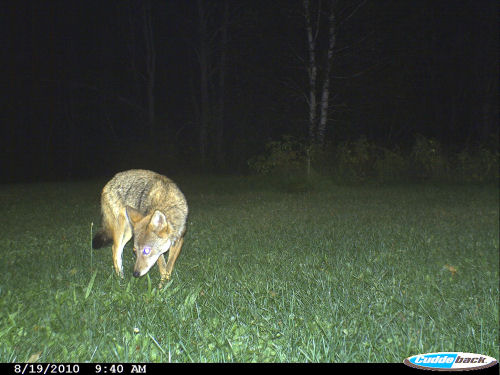
on August 22, 2010 at 04:52:01 PM by Al Sinclair
Stan Gragg sent these photos taken this week in his backyard near Vankoughnet
with his new Critter Cam (a birthday gift). Note the time was incorrect on the
coyote photo. Critter Cams record photos automatically when triggered by a
motion detector. He uses no bait, the bear apparently likes the cherry tree.
Warblers on the move
Posted
on August 22, 2010 at 02:26:54 PM by Barbara
Taylor
We just had a very large mixed flock of Warblers feeding in our birch trees.
The ones I could see clearly enough to identify were Nashville, Blackburnian,
Tennessee, Black-and-white, Pine, Chestnut-sided, Wilson's, and Yellow-rumped.
(Bracebridge)
Henry Road & Trans Canada Trail
Posted
on August 21, 2010 at 06:56:34 PM by dbritton
I birded the Trans Canada Trail between Bracebridge Ponds and Henry Road late
this morning.
Migrant/post-breeding warblers were present amongst flocks of Black-capped
Chickadees and Red-breasted Nuthatches in several locations along the trail.
The following species were observed:
Nashville Warbler (2)
Magnolia Warbler (2)
Blackburnian Warbler (1)
Black-and-white Warbler (1)
Ovenbird (1)
American Redstart (5)
Wilson's Warbler (1) a little early
Common Yellowthroat (2)
David Britton
Ottawa
Re(1): Bracebridge Lagoons
Posted
on August 22, 2010 at 12:40:06 PM by Barbara
Taylor
This morning after the heavy rains eased off we checked out cell 3.
Unfortunately a Merlin was on the hunt so any shorebirds were in hiding. At
least we had great looks at the Merlin which eventually flew towards the
south-west. We relocated the Merlin west of cell 4 perched in a dead tree where
it was being pestered by two Flickers and a Kingfisher!
On our return to cell 3 we did see both Yellowlegs, a Solitary Sandpiper,
Killdeer, and Spotted Sandpipers, but no Snipe. A Least Sandpiper and both
Yellowlegs were at the south shore of cell 1. Four Green-winged Teal were in
cell 3 along with a Hooded Merganser, Mallards, an American Black Duck and Wood
Ducks. A few Common Yellowthroats were in the tall weeds along the roadway and
several Barn Swallows were swooping low over cell 3.
We didn't see the falcon with the jess.
Re(1): Bracebridge Lagoons
Posted
on August 21, 2010 at 10:05:03 PM by Al
Sinclair
The message below was on Ontbirds tonight. A Lanner Falcon is missing from
Ottawa. A Lanner is the size of a Peregrine, looks similar, native to Europe
and Africa. I emailed the owner tonight about your sighting.
From Ontbirds:
I am a falconer who performs work for the government . In June,I lost a Lanner
falcon at the Ottawa Airport.
At one of my educational shows, a kind gentleman referred me to this website
and mentioned that a similar falcon was seen in the Gatineaus' and that there
were reports from Christina Lewis and Bruce DiAbalo.
Emma, 5 year old Lanner Falcon,wearing jesses, gold coloured leg band ALS 519
and Marshall RT Plus
transmitter at 216.085 mhz.
Last seen Sunday, Hanger 11, Uplands Airforce Base.
Any help would be greatly appreciated.
Bracebridge Lagoons
Posted
on August 21, 2010 at 05:45:36 PM by Goodyear
This afternoon there were 8 - 9 Solitary Sandpipers, both Yellowlegs, Least,
Spotted, Killdeer, a single Snipe all in Cell 3. Also observed - a falcon with
a leather jess took down a Ring-billed Gull. The falcon was observed from the
lagoons but was flying around the industrial area to the east (Kia, Mazda,
etc.)
Re(1): painted turtle advice sought
Posted
on August 22, 2010 at 06:54:41 PM by Bob
Bowles
Hi Don;
You are correct that some Midland Painted Turtles and Snapping Turtles do
overwinter in the eggs if they are not ready to hatch in the fall due to colder
or wet weather. Since some of your turtles have hatched this should not be the
case in your situation. I would take the little turtles to the nearest wetland
with pools of about one meter deep. It may be hard to believe but baby turtles
can not swim at first so do not put them in deep water but just along the shore
in the vegetation. As for the unhatched eggs, be careful not to turn them over
and I would bury them in the ground in a safe location. They should hatch soon.
You could also take them to a centre which incubate turtle eggs but I don't
think it will be long before they hatch so I would bury them again near where
you found them.
painted turtle advice sought
Posted
on August 21, 2010 at 04:20:31 PM by Don Clement
Just uncovered nine hatchling painted turtles and one still in shell while
digging a drainage ditch near my garage. I'd like some advice on proper release
methods. I've read that hatchings often overwinter in the nest, but that they
survive only to -12C. With barely four inches of sand, this doesn't seem
likely, so it's probably good I discovered them. I'm next to several large
ponds and I'm thinking of releasing them near the shore, in hope that they'll
find the bottom mud for winter. Any other advice? Also, any advice on helping
the unhatched one?
Thanks!
Belted Kingfisher
Posted
on August 20, 2010 at 07:43:55 PM by Bonnie
Around 7 pm I saw a beautiful Belted Kingfisher on the top of our dock railing
here on Little Lake Joe in Muskoka.
August 20, 2010
Re(1): Was it eating the cherries?
Posted
on August 21, 2010 at 04:20:24 PM by michmsg
Alex, during the time I was there I did not see them eat the berries.
Was it eating the cherries?
Posted
on August 20, 2010 at 09:20:46 AM by Alex
Mills
I have a few times watched Pileated Woodpeckers eating fall or late summer
berries, including dogwood berries. Was this bird eating the cherries?
Re(1): Woodpecker in Port Carling -
photo
Posted
on August 18, 2010 at 05:03:47 PM by Barbara
Taylor
Here is Michele's photo of a Pileated Woodpecker. photo
P.S. - in order to post a photo you first have to upload it from your computer
onto the internet. One of the easiest ways to do this is with tinypic.com
You can practice posting a photo on the Nature Photos Board.
Woodpecker in Port Carling
Posted
on August 18, 2010 at 04:50:00 PM by michmsg
August 6, 2010 during the MLA Boat Show @ the Port Carling Locks.
/Users/michelegoldfarb/Desktop/IMG_0295.JPG
Monarch caterpillar (photos)
Posted
on August 14, 2010 at 08:00:02 PM by Debbie Adams
We have 3 pet caterpillars and today we watched them turn into chrysalis form.
The shedding process took less than 5 minutes, but waiting for the change took
the whole day! Here are 3 photos of the event.
(Walker's Point) photo1
photo2 photo3
Barred Owl
Posted
on August 13, 2010 at 09:30:01 AM by Terry
& Marion Whittam
While watching the meteor shower last night about 11pm, a Barred Owl was
calling for quite some time. 8km east of Washago. "who cooks for you, who
cooks for you all" Cheers Terry
Nighthawk flock
Posted
on August 12, 2010 at 08:49:53 AM by GayleCarlyle
last night at about 7:00pm we watched several large flocks of nighthawks flying
over our house in Washago.
A rough count of about 45 birds.
We guess they're getting ready to head south.
Evening Grosbeaks
Posted
on August 11, 2010 at 05:45:24 PM by DBurton
2 Evening grosbeaks flew over my house in Gravenhurst yesterday... very unusual
for this time of year.
Re(1): Red Crossbills in Achray,
Algonquin Park
Posted
on August 11, 2010 at 05:18:46 PM by Alex
Mills
I had a few Red Crossbills fly over last week at Magnetawan in Parry Sound.
Red Crossbills in
Achray, Algonquin Park
Posted
on August 11, 2010 at 04:45:09 PM by Ontbirds
*This report was originally posted by Lev Frid on ONTBIRDS (August 11, 2010)
and is provided here with the kind permission of the Ontario Field Ornithologists.
Hello Birders,
Myself and Ian Shanahan, on the 7th and 8th (Saturday and Sunday) of
this month, whilst in Achray Campground doing
interpretive programming, heard and saw several Red Crossbills within the
vicinity of the campground. They were mainly near the entrance, feeding on
the ripe cones of the good crop of White Pine that has occurred in the
campground this year. Many sightings were of paired birds and some had
juveniles with them as well. Several males were strongly singing in the
morning. A few birds were also observed on Lake Travers road, eating grit on
the side
of the road.
Directions: Lake Travers in Algonquin Provincial Park can be reached via the
Sand Lake Gate access point, located on Barron Canyon Road. This road is
reached by turningsouth off the Highway 17 bypass onto County Road 26, at a
point 3.5 km west of the Forest Lea Road (approximately 9 km west of
Pembroke),travelling 300 metres, and then turning right at Barron Canyon Road.
Eventually you will reach Sand Lake Gate. The kilometres are marked by
roadside signs. The turnoff to the Achray
campground is at km 38. The Lake Travers parking lot is at km 72.
Good Birding!
Lev Frid
New Yard Bird, Bala
Posted
on August 11, 2010 at 04:32:14 PM by Eleanor
Kee Wellman
Another morning of many warblers feeding in the trees alongside my house and
the most notable was a Golden-winged Warbler. No good pictures but a couple
that confirm identity.
Quacking Duck
Posted
on August 11, 2010 at 08:09:17 AM by Chris
We have a resident female mallard that incessantly quacks.
It seems to be on it's own. When it approaches other mallards they turn away
but don't appear to be bothered
by her. When she stops quacking for seconds at close range
I could hear something like a grunting - wondering if this is normal behavior
and she is just a yacky quacky duck.
The quacking starts just after sun rise.
Bonaparte's Gull - Dollar's Lake
Posted
on August 10, 2010 at 04:39:24 PM by Kip
Daynard
I forgot to mention I saw an adult Bonaparte's Gull on Sat. Jul 31st on the
north end of Dollar's Lake in NW Parry Sound district. It's not a bird I often
see in Muskoka/Parry Sound so thought it was worth mentioning. I see one most
years on this lake at this time of year - I understand that the adults come
south from northern breeding grounds in late July.
Google map location:
http://maps.google.com/maps?f=q&source=s_q&hl=en&geocode=&sll=37.0625,-95.677068&sspn=50.644639,112.763672&ie=UTF8&hq=&hnear=Dollars+Lake&t=h&ll=45.963501,-80.175347&spn=0.02118,0.043859&z=15
Caspian Terns are also regulars on the lake, always single birds. This is about
45kms from breeding sites near the mouth of the French River so perhaps they
are visiting from those colonies.
Osprey are also pretty regular and likely breed close by although I've never
seen a nest.
Re(2): Nighthawks
Posted
on August 10, 2010 at 08:57:00 PM by janice house
2 nighthawks flying around our neighbourhood at 8pm tonight, I watched them for
20 minutes
Re(1): Nighthawks
Posted
on August 10, 2010 at 08:13:22 PM by Barbara
Taylor
Just before 8 p.m. tonight there were a few Common Nighthawks flying over our
house. I wonder if they are the same ones Ted saw yesterday (we're only a
couple blocks away), or if migration has started early this year? (Bracebridge)
Nighthawks
Posted
on August 9, 2010 at 10:59:38 PM by ted gardner
A half dozen Nighthawks spent 10 minutes tonight feeding over the house at
aprox 6:30 pm
120 meadow heights
Spotted Coral-root - an orchid
Posted
on August 9, 2010 at 08:02:09 PM by Al
Sinclair
Photo today at Hardy Lake PP Spotted Coral-root - Corallorhiza_maculata
photo
Re(2): Missing monarchs
Posted
on August 14, 2010 at 01:48:47 PM by Barbara
Taylor
It's about the right time...usually by mid-August some are moving south from
our area.
Re(1): Missing monarchs
Posted
on August 11, 2010 at 10:19:31 PM by rosebury
Tonight around 7:30pm there were hundreds of Monarch butterflies flying pretty
high in a westerly direction, is it too early for their migration?
Severn Bridge, ON
Re(3): Missing monarchs
Posted
on August 9, 2010 at 06:18:53 PM by ted gardner
Here are 3 of 8 i found on a small hill beside my driveway with a total of 3
plants. photo
Re(2): Missing monarchs
Posted
on August 6, 2010 at 07:10:14 PM by Al
Sinclair
Here east of Bracebridge Joan has some Showy Milkweed, Asclepias speciosa, in
her flower garden. We only noticed one female monarch in the yard, about 3
weeks ago. I counted 6 caterpillars tonight, 4 almost ready to pupate, 2 only a
few days old. We have had about the same in other years but they were earlier
when the milkweed was still blooming so Joan makes me move them to wild plants
down the road. This year they get to stay.
Re(1): Missing monarchs
Posted
on August 6, 2010 at 02:41:49 PM by J.
Gardner
Here in Hurdville, we seem to have a fair number of Monarchs flying about. But,
we haven't seen any caterpillars yet. The milkweed (if anybody needs any, help
yourself) is way past the flowering stage and the pods are already well-filled.
Many of the milkweeds are in the process of drying up without flowers or pods.
Re(1): Missing monarchs
Posted
on August 7, 2010 at 09:35:10 AM by mmcanally
We live on Britannia Road in Huntsville. I have seen more Monarch caterpillars
around our property this year than ever. Also, more milkweed than previous
years. I have seen three caterpillars on some milkweeds.
Missing monarchs
Posted
on August 6, 2010 at 09:35:55 AM by GayleCarlyle
Is anyone else experiencing a lack of monarch caterpillars this year? We allow
the common milkweeds to grow in the garden near our house so we can watch the
caterpillars throughout the summer.
But this year, we have not seen any. Only one adult earlier in July on the
swamp milkweed but that's it.
Hopefully this doesn't mean a serious decline in the population.
I'd be interested to hear from other folks.
Green River Drive, Washago
Common Buckeye in Algonquin Park
Posted
on August 4, 2010 at 06:59:41 PM by rick
stronks
We now have our second Common Buckeye record this summer in Algonquin Park. One
was seen on July 31 at the old airfield at Mew Lake Campground. We also had one
near Cauliflower Lake along the hydrocut south of Whitney on July 22nd.
Before this year, we only had two other records. Now I'm hoping for Little
Yellow and American Snout!
Rick
Common Tern Colony
Posted
on August 4, 2010 at 11:00:17 AM by sylviaandjim
The Common Tern Colony on the whalerock in the Severn River between the
HydroGlen railway bridge and SwiftLock. The boundary is right on the line of
Muskoka and Matchedash. Count is est. +-12juveniles on the wing from July 25 to
Aug.2. Est. 15-20 adults reported active breeding in early May & June.
Whalerock has no access and is surrounded by sharp rocks in the water, so our
numbers are estimates. DCCormorants in the area on a pos. breeding tree on the
mainland on the Muskoka side-(2-3 pr.) Caspian Terns active adults with young
on the islets near our Island 32, but no evidence of nesting in the immediate
area.
Re(2): Common
Nighthawk Migration? - east of Grundy Lake
Posted
on August 4, 2010 at 11:50:43 AM by Kip
Daynard
Thanks George,
I think you must be right. I guess I just happened across a mini hot-spot for
CONI. The numbers imply between 5 and 10 nests.
e.g. 2 broods of 2 chicks each (4 fledged birds per pair) with all birds in the
sky: 27/6 = 5 nests. Two fledged per pair translates to 27/4 = 7 nests. 1
fledged per pair: 27/3 = 9 nests.
Re(1): Common Nighthawk Migration? -
east of Grundy Lake
Posted on
August 4, 2010 at 10:55:52 AM by george
bryant
Kip,
I keep track of high counts of Ont birds
Here are my CONI figures:
2100 / August 16, 1975, TCHwy @ Massey, AW
1129 / August 27, 2001 High Park@ Bloor (GlCo)
1000 / Sept. 2, 1993, Victoria Park, Hamilton (WS)
340 / August 29, 2004, Kingston / 401 David Agro
800 / August 26, 1994 MT
706 / August 31, 1944, TO backyard, R.M. Saunders
I suspect some of your birds are just fledged young as it is 3 weeks too early
for migration.
George Bryant
Gravenhurst
Common Nighthawk Migration? - east
of Grundy Lake
Posted
on August 3, 2010 at 02:54:50 PM by drongo
Monday evening at 7:40pm we saw 27 Common Nighthawks flying over a 1.5km
stretch of Hwy 522 about 15kms east of Grundy Lake in NW Parry Sound district.
They appeared to be hawking insects as one would expect at this time of night
but I was surprised by the numbers. I can't see what would make this particular
stretch of road more attractive than any other in the area.
Could this be an early migratory movement? The numbers suggest so but it seems
early by a few weeks. That said, the following blog post suggests it may not be
so early: http://stokesbirdingblog.blogspot.com/2009/07/nighthawk-migration-will-be-starting.html.
According to that post the nighthawk migration survey in MA and NH starts Aug.
9th.
Based on the survey's website, the migration appears to peak in New England
between Aug. 21st and Aug. 30th. http://www.borobirding.net/survey-historical-results.html
Does anyone know if any such survey is being done in Ontario?
Here's a Google Map link to the location of my sighting:
http://maps.google.com/maps?f=q&source=s_q&hl=en&geocode=&sll=37.0625,-95.677068&sspn=50.644639,112.763672&ie=UTF8&hq=&hnear=Dollars+Lake&t=h&ll=45.901597,-80.36808&spn=0.087682,0.220242&z=13
Kip Daynard
Gravenhurst
Re(1): Purple Martin colony - Parry
Sound District
Posted
on August 6, 2010 at 07:18:19 PM by Al
Sinclair
This is the first active colony I have heard of in either district. It is
surprising news! It is also good news and gives us hope that they will return
to central Ontario in good numbers if their breeding success improves.
Purple Martin colony - Parry Sound
District
Posted
on August 3, 2010 at 02:22:48 PM by drongo
We spend a week every summer on Dollars Lake in north-central Parry Sound
district (on Pickerel River system). I occasionally see a lone Purple Martin
flying on Dollars Lake and have often wondered if there was an established
colony somewhere in the area. This year I found it - a well-maintained pair of
Martin houses, one of which the owner claims has been occupied for at least 35
years. The owner claims there are about 20 pairs which looked about right given
the size of the house and the number of birds flying about.
Here's a link to the Google Map location:
http://maps.google.com/maps?f=q&source=s_q&hl=en&geocode=&sll=37.0625,-95.677068&sspn=50.644639,112.763672&ie=UTF8&hq=&hnear=Dollars+Lake&ll=45.90312,-80.272079&spn=0.02192,0.05506&t=h&z=15
Has anyone else seen Purple Martins in Muskoka or Parry Sound this year?
Kip Daynard
Gravenhurst
Re(1): Nectar mixes
Posted
on August 3, 2010 at 11:25:23 AM by Barbara
Taylor
ONLY use white sugar and water!
See this website for more info...
http://www.hummingbirds.net/feeders.html
Nectar mixes
Posted
on August 3, 2010 at 09:54:54 AM by MikeWeiss
Hello All,,, Is it best when making Nectar mixes for Hummingbirds and Orioles
to use White or Brown sugar ...
Re(1): strange loon behaviour with
babies
Posted
on August 3, 2010 at 06:40:14 AM by Eleanor
Kee Wellman
When a loon chick is about 3-4 weeks old the adults will start to leave it on
its own in places they consider safe. They are left on their own and told to
stay there until the adults return.
This can happen when other loons come into the area or there is other danger.
You are right about the Canada Geese. Loons don't like them and will chase them
away so don't know what would have been going on for one of the chicks to be
with them.
If the fishing is not good for the loon adults and they are having a difficult
time feeding two chicks they have been known to drive a chick away and abandon
it. Usually they drive it onto land, though. Don't do anything about a chick
that you think might have been abandoned until talking with Janice Enright at A
Wing and a Prayer, though.
strange loon behaviour with babies
Posted
on August 3, 2010 at 04:19:39 AM by GFarkas
We live on a small lake in the Parry Sound region. About a week ago, neighbours
spotted a small baby loon that was all by itself in the water with no adult
loons in sight. Obviously the baby appeared distressed and we could hear it
crying. We watched it for a few hours and eventually a pair of adult loons
appeared. For a few days we saw the baby again as part of this family and
everything seemed normal. However, the fact that the baby appeared to be alone
for so long seemed very strange to us. Do loons “abandon” chicks like this for
any reason?
Then another strange behaviour was observed. A family of young geese was on one
of the neighbours lawns and the baby loon was swimming in the bay in front of
that lawn, again with no adult loons in sight. When the geese were shooed off
the lawn, the baby loon swam away in the middle of the family of geese. Do
geese ever adopt stray loon chicks? I was under the impression that geese and
loons did not get along.
Yellowlegs
Posted
on August 2, 2010 at 06:41:05 PM by Barbara
Taylor
This morning at the Bracebridge Ponds there were two Lesser and one Greater
Yellowlegs in cell 3. They were towards the east end amongst a bunch of Canada
Geese.
Woodcock
Posted
on August 2, 2010 at 00:24:52 AM by kfraser
I saw an odd little bird today on the side of Cedar Shores road and when it
didn't fly or run away when I drove by , I backed up to see an odd little bird.
I had never seen such a bird before but after searching on the Internet I
deduced it was a Woodcock. I have never seen one before but was fascinated to
see one today.
Karen
Imperial Moth Caterpillars
Posted
on July 26, 2010 at 03:02:28 PM by DRHinzmann
We've found 6 or 7 Imperial Moth Caterpillars at Santa's Village during the
last 2 weeks or so. Also found some there last summer.
Re(1): Need help identifying a bird
call
Posted
on August 9, 2010 at 09:47:03 AM by iheathco
Thanks to you all for your responses. Rick Stronks and his staff have
identified the call as a Winter Wren, so I learned something new. It sure is a
vigorous little singer! I have a clear recording of the call but can't figure
out how to post it on this site. If you want to hear it, email me and I'll send
it along by email.
Re(4): Need help identifying a bird
call
Posted
on July 28, 2010 at 05:35:53 PM by Doug
Smith
Dos it sounds something like a coin dropping on a hard surface, with the noise
accelerating as it finally stops?
If so it may be a field sparrow.
Re(3): Need help identifying a bird
call
Posted
on July 27, 2010 at 03:18:32 PM by rick
stronks
Could the bird be American Goldfinch? You might want to try to listen to that
track again.
A good website for bird song/calls is www.allaboutbirds.org
Good luck
Rick
Re(2): Need help identifying a bird
call
Posted
on July 27, 2010 at 08:27:01 AM by iheathco
I don't have a camcorder, but I think there's a voice memo feature on my phone.
Maybe I'll try that. Good suggestion - thanks!
Re(1): Need help identifying a bird
call
Posted
on July 27, 2010 at 08:25:28 AM by Eleanor
Kee Wellman
Any possibility you have a camcorder or something else you could record the
song with? Then you could post the song.
Need help identifying a bird call
Posted
on July 26, 2010 at 10:17:04 AM by iheathco
Can anyone help me identify a bird I hear singing every day in the bush off Hwy
117 near Bonnie Lake Road? it's a complex vocalization beginning with a
syncopated warble and finishing with a series of rapid notes, all on the same
tone. It sounds like "deet-de-deet-de-deeee da da deet-de-deet-de-deee da
da d-d-d-d-d-d-d" Sometimes the final series of notes sounds more like a
buzz or brrrr than individual notes. Sometimes the sequence is followed by
another warble.
I have been through all of Peterson's Birding by Ear CDs, volumes 1 and 2, and
have not been able to identify a call anything like this. I'd be grateful for
any information you can provide!
Wrens
Posted
on July 26, 2010 at 08:58:56 AM by J.
Gardner
Has anybody else noticed an increase in the House Wren population? Our bluebird
and swallow boxes are rapidly being taken over, here in Hurdville and around
the area. Noticed this morning that one pair, at least, which has already had
two successful nests, is still interested in starting on another nest. And
those boxes which don't have nests, are full of timber. They set one nest on
top of a brood of swallows, which, considering the shrinkage in that
population, was disturbing. Jim surmises that the rapid disappearance of open
fields is inviting the little blighters in.
Ruddy Duck, Solitary Sandpipers -
Bracebridge Ponds
Posted
on July 24, 2010 at 01:29:49 PM by Barbara
Taylor
The male breeding plumage Ruddy Duck reported July 19 is still in cell 1. Two Solitary
Sandpipers and a Least Sandpiper were at the south end of cell 1. Unfortunately
the Ponds are not very shorebird friendly right now since water levels are
quite high and there are no exposed mudflats. Also, construction of the new
plant continues south of cell 3 - seems they only stop work on Sundays.
A Green Heron flew past heading west of cell 4. A female Common Goldeneye was
in cell 4...she has spent the whole summer there. We had thought she must be
injured, but today she flew up and circled the pond briefly before coming back
in for a landing.
Oriole Babies
Posted
on July 23, 2010 at 07:02:17 PM by MikeWeiss
Hello All,, im in the Penetang area,,,what date do the Orioles usually have their
babies... thanks Mike.. Also spotted 2 Gray Catbirds the other day ..(One was
larger the the other)..
Bat Box Building Workshop
Posted
on July 23, 2010 at 04:55:27 PM by Doug
Smith
Saturday, July 31st, the Muskoka Lakes Museum is putting on a Bat Box Building
Workshop, from 10 am to noon. All ages are welcome, with parental supervision.
Cost is $10 per person, and includes materials. Please bring your own hammer or
portable drill. Call the museum at 765-5367 to reserve a place. (this message
was preapproved by Bird Board admin.)
The Muskoka Lakes Museum is located on James Bartleman Island Park in Port
Carling -- between the locks. Parking is available on the village streets
nearby.
Bat lecture at museum
Posted
on July 23, 2010 at 04:51:09 PM by Doug
Smith
On Wednesday, July 28th, at 7 pm Christy MacDonald, a biologist with the
Ministry of Natural Resources, is speaking about Bats. After the talk Christy
will use a ‘bat detector’ to listen for bats outside the museum. Cost is $5 or
$3 for members. (This message was preapproved by Bird Board admin.)
The Muskoka Lakes Museum is located on James Bartleman Island Park in Port
Carling -- between the locks. Parking is available on the village streets
nearby.
Bulbous Water Hemlock
Posted
on July 21, 2010 at 04:20:09 PM by Barbara
Taylor
There was very little in the way of bird life at Henry Marsh this
morning...several Canada Geese on the beaver pond and a Belted Kingfisher
perched on the bridge. Unfortunately it started to rain, but I did manage to
grab a couple shots of these Bulbous Water Hemlocks in bloom. Delicate looking
flower...but the plant is deadly poisonous apparently. (Bracebridge)
photo1
photo2
References:
http://www.ontarioweeds.com/weed.php?w=CIUBU
http://ontariowildflowers.com/main/species.php?id=116
Great Gray Owl in Algonquin Park
Posted
on July 20, 2010 at 07:23:27 PM by Ontbirds
*This report was originally posted by Ron Tozer on ONTBIRDS (July 20, 2010) and
is provided here with the kind permission of the Ontario Field Ornithologists.
A Great Gray Owl was observed and photographed in the
Dizzy Lake area (near post 12) of Mizzy Lake Trail on
18 and 19 July. This may be the same individual that was
seen in that area on 13 June. A small population of this
boreal species is believed to breed regularly within
Algonquin Park.
The Dizzy Lake area is most easily accessed by going
backwards on the Mizzy Lake Trail from its beginning
at the junction of Arowhon Road and Highway 60 at
km 15.4. There is a map of the trail in the trail guide,
available at the trail entrance.
We would appreciate receiving your Algonquin Park
bird observations for our Visitor Centre records.
Ron Tozer
Algonquin Park Naturalist (retired)
Dwight, ON
Directions:
Algonquin Park is three hours north of Toronto, via
Highways 400, 11 and 60. Follow the signs, which start
in Toronto on Highway 400. From Ottawa, take Highway
17 to Renfrew, then follow Highway 60 to the park.
Kilometre markers along Highway 60 in the Park go from
the West Gate (km 0) to near the East Gate (km 56). Get
your park permit and the park tabloid (with a map of
birding locations mentioned here) at the gates.
The Visitor Centre at km 43 has details on recent natural
history sightings and park information. Birders should
ask at the front desk about the latest bird observations.
The Visitor Centre is now open daily from 9 am to 9 pm.
Re(1): Young birds in the yard...
Posted
on July 23, 2010 at 11:53:40 AM by Al
Sinclair
Here in the last couple of weeks we have had recently fledged Purple Finch,
Hairy Woodpecker, and White-throated Sparrow. 8km east of Bracebridge
Young birds in the yard...
Posted
on July 20, 2010 at 01:52:56 PM by Barbara
Taylor
We've been seeing several young birds foraging on their own now without any
parents in sight. Over the past few days the zillions of Blue Jay fledglings
have "graduated" and the Red-breasted Nuthatches and Black-capped
Chickadees are no longer begging for food. The juvenile White-breasted
Nuthatches have been fending for themselves for some time and the young
Great-crested Flycatchers, Northern Flickers, Downy Woodpeckers, Hairy
Woodpeckers, Eastern Phoebes, and one young male Northern Cardinal also seem to
be on their own now. Yesterday there were three immature Yellow-rumped Warblers
taking turns in the bird bath. This morning we had a young male Rose-breasted
Grosbeak stop by for a visit - he only had a bit of buffy orange tint on his
breast but the red underwing linings were very colourful. (Bracebridge)
Re(1): A Greater
Fritillary...Aphrodite
Posted
on August 3, 2010 at 09:01:18 PM by Kip
Daynard
Saw a Great Spangled Fritillary on Dollars Lake in NW Parry Sound district on
Jul. 21st. Alas no pictures.
Re(2): A Greater
Fritillary...Aphrodite
Posted
on July 26, 2010 at 01:16:01 PM by Al
Sinclair
eye colour reference: Kaufman Focus Guide - Butterflies
Seems to be reliable but these two species have been few and far between here
for a few years, so haven't had a large sample to compare.
Re(1): A Greater
Fritillary...Aphrodite
Posted
on July 24, 2010 at 04:34:52 PM by rick
stronks
Al - I've never seen a reference before for eye colour between these two
species. Do you feel this is a reliable field mark? I will certainly start
noting eye colour.
Thanks, Rick.
A Greater Fritillary...Aphrodite
Posted
on July 20, 2010 at 12:26:05 PM by Al
Sinclair
This Aphrodite was in our yard today feeding on Joan's oregano, best butterfly
plant here at the moment. There are three Greater Fritillary species found in
Muskoka, Aphrodite, Atlantis, Great Spangled. Note the eye colour is
yellow-green, Atlantis is blue-grey. Atlantis also has black wing margins on
the upper side of both wings. Great Spangled has broader band of yellow on the
under side of the hind wing. 4451 - Aphrodite Fritillary - Speyeria
aphrodite photo
Frostweed/FBO field trip
Posted
on July 19, 2010 at 06:16:34 PM by Al
Sinclair
I was fortunate to participate in a Field Botanists of Ontario field trip in
the Mactier area on July 10, 2010. Leader Jim Goltz, formally from Bala now
Fredricton N.B., showed us dozens of interesting and rare plants in the bogs
and sandy soils around town. The photo of Frostweed below was taken in the sand
pits next to Hwy 69 and is the only know location for this species in Muskoka.
It gets its name from the many white hairs on the stem and leaves that look
like frost. Canada Frostweed - Helianthemum canadense photo
Ruddy Duck - Bracebridge Ponds
Posted
on July 19, 2010 at 01:44:16 PM by dbritton
A bit of a belated message, but yesterday (Sunday, July 18) morning there was a
male breeding plumage Ruddy Duck in the NW corner of Cell 1 (the NE cell). It
was visible from the viewing platform in Kerr Park.
Also of note an adult Green Heron flew over the ponds heading west towards the
Henry Road Marsh.
A Tussock Moth Caterpillar
Posted
on July 19, 2010 at 09:39:06 AM by Al
Sinclair
White-Marked Tussock Moth found July 16 near Barkway by Nicholas
Speicher. 8316 - White-marked Tussock Moth - Orgyia leucostigma photo
Green Herons at Kerr Park
Posted
on July 18, 2010 at 12:36:36 PM by Barbara
Taylor
Today at noon there were two Green Herons at the edge of the little pond at
Kerr Park...one adult and one juvenile. This is the first time we've seen a
young one this year and still haven't figured out where their nest was.
(Bracebridge)
Re(1): Phoebes & Deer Flies
Posted
on July 18, 2010 at 07:20:15 PM by Terry
& Marion Whittam
Deer flies are just slightly less this year 10km east of Washago. We also have
a local Phoebe! This past weekend we noticed reduced deer flies for the first
time! Cheers Terry
Re(3): Phoebes & Deer Flies
Posted
on July 18, 2010 at 10:49:49 PM by dinnymccraney
Lots of deer flies here (Bracebridge) and quite a few black flies in the last
few days...glad I wasn't imagining things!
Re(2): Phoebes & Deer Flies
Posted
on July 18, 2010 at 01:45:09 PM by Barbara
Taylor
When walking the trails by the Bracebridge Ponds and Henry Marsh there seemed
to be a bumper crop of Deer Flies this year, although not so bad right now. And
has anyone else noticed the recent return of some Blackflies? Seems they came
early and then died off very quick this year which made for an unusually
pleasant gardening season. But over the past week they've returned...at least
to our yard. (Bracebridge)
Re(1): Phoebes & Deer Flies
Posted
on July 18, 2010 at 01:35:09 PM by J.
Gardner
Deer Flies!!! No reduction in Hurdville. Care to lend me a pair of nesting
phoebes? June
Phoebes & Deer Flies
Posted
on July 18, 2010 at 11:29:02 AM by Eleanor
Kee Wellman
Since I bought my place in 1998 I have been plagued by deer flies.
This year, for the first time, phoebes have nested on a platform under the
eaves. From video I have taken I can see that the phoebes are feeding deer
flies to the young as one of their prey items.
I have very few deer flies this summer. Does it follow that the phoebes are
reducing the population or is it just the weather? Has anyone else noticed a
reduction in the deer fly numbers?
bobolinks
Posted
on July 18, 2010 at 08:48:51 AM by carolwagg
Was scolded by 4 bobolinks this morning as I walked near the crest of the hill
just past 1611 Doe Lake Road (Gravenhurst). There had been a pair, so Nature
seems to be taking its course.
Re(1): mystery plant
Posted
on July 17, 2010 at 10:35:08 PM by PatWelch
The plant is a flowering raspberry. My neighbour on the Aspdin Road has them
growing in her yard. A few years ago she gave us some plants which have now
become established in our yard.
Re(1): mystery plant
Posted
on July 17, 2010 at 10:28:07 PM by Barbara
Taylor
Looks like Rubus odoratus (Purple-flowering Raspberry).
http://www.ontariowildflower.com/shrub.htm#raspberrypurple
Re(1): mystery
plant
Posted
on July 17, 2010 at 07:15:05 PM by CatMacLean
Can anyone identify? I thought it was a striped or moose maple but the flowers
don't match. photo1
photo2
Two Hairstreaks
Posted
on July 15, 2010 at 10:15:41 PM by Al
Sinclair
Two hairstreak species on the same leaf, very unusual considering how hard
hairstreaks are to find. Coral and Acadian, photo taken by Jim Goltz July 9,
Depot Harbour Parry Sound District. 4275-4278 - Coral Hairstreak &
Acadian Hairstreak - Satyrium titus- Satyrium acadicum photo
Yellow-throated Vireos...Torrance
Posted
on July 14, 2010 at 08:44:44 PM by Al
Sinclair
Jim Goltz sent the following sighting report from July 11.
On Sunday I found 2 singing Yellow-throated Vireos on the Southwood Road. When
driving from Torrance, after you have passed the turnoff to Nine Mile Lake, and
gone over the railway track and around the corner, you will see a cluster of
signs on both sides of the road. The vireos were near the last of these signs.
One was on each side of the road.
Question Mark flying at Bracebridge
Posted
on July 14, 2010 at 06:27:46 PM by Al
Sinclair
We had a nice fresh Question Mark drop in here on our veranda for a brief visit
this afternoon. Got a shot of the underside but not the top. The underside
shows the silver "question mark" that gives it its name. 4420 -
Question Mark - Polygonia interrogationis photo
Bala Backyard Birds
Posted
on July 14, 2010 at 07:24:20 AM by Eleanor
Kee Wellman
The pin cherry trees that are growing next to my house are bringing lots of
birds in. They have eaten all the cherries and are looking for bugs. So far,
Black-throated Green Warbler(only sighting here this year), Nashville feeding
juvenile, Blue-headed Vireo several times, Red-headed Vireo is a regular. The
chickadees and Purple Finches (two families) are in them regularly.
Yesterday three Nashville Warblers were looking for food in the cosmos right
outside my door.
Ovenbird and Black & White around as well as family of Great-crested
Flycatchers. The phoebe's second family has just hatched.
Re(1): ID needed
Posted
on July 13, 2010 at 09:30:06 PM by Al
Sinclair
8897 Metalic Looper, Diachrysia balluca
ID needed
Posted
on July 13, 2010 at 09:11:29 PM by Ted Gardner
Can't seem to pin point this one....the green is very iridescent...once againf the
Home Depot Garden centre. photo
Re(1): Muskoka moth
Posted
on July 13, 2010 at 09:27:41 PM by Al
Sinclair
Badly beaten up but that's what it is.
Muskoka moth
Posted
on July 13, 2010 at 09:01:09 PM by Ted
Gardner
I think this is a Small eyed sphinx...Home Depot Garden Centre photo
Whimbrel - Algonquin Park
Posted
on July 13, 2010 at 05:08:37 PM by Ontbirds
*This report was originally posted by Justin Peter on ONTBIRDS (July 13, 2010)
and is provided here with the kind permission of the Ontario Field Ornithologists.
Good morning birders:
A Whimbrel was seen this morning three times, flying and vocalizing over the
Old Airfield and Lake of Two Rivers in Algonquin Park, coincidentally during a
guided bird walk. This would be only the 6th record of Whimbrel for Algonquin
Park, ever.
Good birding!
Justin Peter
Park Naturalist / Interprète-naturaliste
Visitor Centre / Centre d'accueil
Algonquin Provincial Park / Parc provincial Algonquin
Ontario, Canada
613-637-2828 x. 223
justin.peter@ontario.ca
Sora in an odd place
Posted
on July 12, 2010 at 03:07:27 PM by Kip
Daynard
Last week shortly after dark around 9:30pm, while sitting in our Muskoka room
one evening, I heard the unmistakable descending whinny of a Sora from the wet
woods to the north-east side of the house. This is nothing like the usual
habitat one would expect to find a Sora in - being entirely treed and lacking
deep grasses or reeds, but I feel certain about the ID as I've heard them many
times before and can think of nothing else this could be. There are a few
marshes in the area suitable for Soras so all I can think of is that it was
en-route somewhere, perhaps looking for other Soras to gather with before the
fall migration.
Here is an interesting article on Soras: http://www.birdsbybent.com/ch61-70/sorarail.html
from which I've taken a few quotes:
"Fall.--During the late summer and early fall, when the seeds of the wild
rice, wild oats, and other aquatic plants are ripening and falling, the soras,
greatly increased in numbers with their large broods of young, desert their
breeding grounds and gather in great multitudes in the more open marshes on the
rice-covered borders of the lakes and streams, where they feast and fatten on
their favorite food. At such times a sudden noise, such as the report of a gun
or the splash of a paddle or a stone thrown into the grass, will start a chorus
of cries ringing from one end of the marsh to the other. In such places they
remain until driven farther south by the first frosts. They are very sensitive
to cold and are good weather prophets. After a frosty night, in late September
of early October, a marsh, which was teeming with rails the day before may be
found entirely deserted, every bird having departed during the night. They have
started on their autumn wanderings, their fall migration."
"Once breeding has been completed, soras become gregarious, gathering in
large numbers as they fatten up for migration. Although the sora appears to be
a weak flyer, during migration it makes lengthy flights, sometimes crossing the
Gulf of Mexico and the Caribbean as it overwinters in South America. Migration
patterns are mostly nocturnal." (Kaufman, 1996)
For more of my sightings, please visit my nature blog:
http://www.kipdaynard.com/nature
Gray Wolf near Port Sydney
Posted
on July 12, 2010 at 02:25:07 PM by Kip
Daynard
On Tuesday, June 29th at around 7:30pm Andrew Paterson and I saw what we
believe to be a Gray Wolf at North Granite Ridge golf course near Port Sydney. It
was seen briefly on the 7th hole at close range (~40m) and then again on the
9th hole at longer range (150m). It appeared to be following a deer, as a
good-sized doe had crossed the fairway within 30 ft of us just a minute or two
earlier in a rather agitated state.
I think it was a Gray Wolf mainly because, in contrast with coyote sightings, I
was immediately struck by its 'wolfness' - immense in size, it stood waist high
and appeared stockier, with a stouter snout and overall build than any Coyote
I've seen. I'd say it was fairly light-colored overall: mostly gray, but with a
fair amount of reddish and a touch of black.
We also saw a Merlin fly low over the 5th or 6th hole.
For more of my sightings, see my nature blog at: http://www.kipdaynard.com/category/nature
my favorite frog
Posted
on July 12, 2010 at 01:47:44 PM by John
Challis
Grey treefrogs began congregating around the new pond we have built in our front yard (Washago, Green River Drive), almost as soon as the pump began running. In mid-June there was quite a chorus of competing males and I was able to capture one in full song -- by capture, I mean on camera. He stayed of his own volition, along with several other lovestruck males. He stayed all next day, apparently quite beat from the night's romance. photo
I have photos of him resting on a Facebook page, if the link below works. He changed colours through the day quite nicely to match the driftwood. Hyla versicolor on Facebook
Re(2): ID for dragonfly
Posted
on July 14, 2010 at 09:41:18 PM by John
Challis
Thanks Al. Although I have some reservations about shouting "show me your
genitalia" next time I'm photographing dragonflies.
Re(1): ID for dragonfly
Posted
on July 14, 2010 at 01:29:51 PM by Al
Sinclair
Eyes don't touch in the middle, therefore Clubtail (Gomphus)
Possible exilis, lividus, spicatus (side stripes, most common sp. here)
Need closeup of genitalia next time, side for male, underside for female. Also
photo of spots topside of the last 3 segments of the abdomen.
My guess: Gompus spicatus, Dusky Clubtail
ID for dragonfly
Posted on
July 12, 2010 at 01:34:02 PM by John
Challis
We now have two good books on odonates, but haven't been able to track this creature down. It's a large dragonfly - 5 to 6 cm long - but kept its wings tucked back like a damselfly. Found on our side steps at home in Washago, back in June. photo
Re(2): Tiger Beetle in Muskoka
Posted on
July 13, 2010 at 04:45:26 PM by Al Sinclair
Thanks for checking your records, will start looking for the green one. It
looks like the Six-spotted Tiger beetle, Cicindela sexguttata, the most common
species in Ontario. The brown one looks like the same one I saw at Mactier. The
Tiger Beetle website is at http://www.uoguelph.ca/debu/tiger-beetles.htm
Re(1): Tiger Beetle in Muskoka
Posted
on July 13, 2010 at 12:13:59 PM by DiannaWolfe
We routinely see Tiger Beetles; however, I must admit that I have not been
recording their locations. They are notoriously difficult to photograph as they
are very flighty, being equally adept at both terrestrial and aerial movement.
That said, I have three sightings for which I have archived photos and
consequently know locations. In Muskoka-Parry Sound, I have a photo from near
Mactier in 2009 (Photo 1). Photo 2 appears to be a similar or the same species
as Photo 1 and was taken west of Sudbury this year. Photo 3 appears to be the
same species you photographed in Mactier and was taken near Petroglyphs
Provincial Park (Kawarthas) in 2008.
Re(3): Tiger Beetle in Muskoka
Posted
on July 14, 2010 at 09:22:05 AM by Dawn Sherman
Thanks for the info.! I think I will go and check it out sometime.
Re(2): Tiger Beetle in Muskoka
Posted
on July 13, 2010 at 04:51:00 PM by Al
Sinclair
I suppose this species is about one inch long, larger than the others. The
Mactier sand plane covers a large area around the town. The beetle was seen in
the sand pits beside hwy 69 and are not posted or fenced.
Re(1): Tiger Beetle in Muskoka
Posted
on July 12, 2010 at 07:59:42 AM by Dawn
Sherman
How big is a Big Sand Tiger Beetle? Also, is there public access to the sand
plane?
Tiger Beetle in Muskoka
Posted
on July 11, 2010 at 09:26:42 PM by Al
Sinclair
This is the first one for me. Seen on the Mactier sand plane July 10. Anyone
else seen Tiger Beetles? (photos are frame grabs from video)
Big Sand Tiger Beetle - Cicindela formosa photo1
photo2
Cicindela formosa Location 45 7' 35.2"N, 79 44' 46.2"W : map
From Tiger Beetles of Ontario: The most conspicuous tiger beetle of inland dunes and sand blowouts, especially those close to the Great Lakes, is our largest tiger beetle, Cicindela formosa. These big brown or reddish brown beetles are distinctive not only for their size, but also for the cream-coloured markings that extend in a broad band around the edge of the wing covers, and extend onto the wing covers as thick, finger-like extensions. These elegant beetles occur as far north as Orillia and Ottawa, but they are most common farther south where large numbers can be seen in spring. Some adults can still be found through to late August.
another Sphinx moth
Posted
on July 11, 2010 at 08:29:53 PM by Ted
Gardner
also taken at Home Depot garden centre, a Big Poplar Sphinx? photo
also spotted but no pic a Pawpaw sphinx
Sphinx moth
Posted
on July 11, 2010 at 08:23:36 PM by Ted
Gardner
pic today at Home Depot garden centre...believe it to be a
Laurel Sphinx, thanks to Muskoka Moths Live website. photo
Re(2): (no subject)
Posted
on July 11, 2010 at 07:55:02 AM by DebbieCrozier
Thanks ever so much for your help. I have been reading about them this morning.
They definitely were Northern Flickers (Yellow Shafted). I was fascinated by
their golden colour, when in flight. I actually thought they looked like a
woodpecker, but I never researched that catagory, because they were feeding on
the ground.
Thanks again.
Re(1): (no subject)
Posted
on July 10, 2010 at 09:50:21 PM by ron tozer
Hi Debbie:
The birds are Northern Flickers. They are woodpeckers that specialize in
feeding on ants on the ground, which is what the birds in your photos appear to
be doing.
(no subject)
Posted
on July 10, 2010 at 08:13:12 PM by DebbieCrozier
I do apologize beforehand. I am very new at birding. AND, I am very new at posting pics to websites. I saw 3 of these birds in my back yard yesterday, and I have no idea who or what they are. I would appreciate any info. photo1 photo2
Thank you. Debbie
Cicada's
Posted
on July 8, 2010 at 08:37:16 AM by Debbie Adams
Since Monday, I've heard Cicada's. They seem to be earlier than previous
summers but I suppose that is because it hasn't been as hot for this long in
recent years.
New location for Arrowhead Spiketail
Posted
on July 6, 2010 at 02:04:13 PM by Al
Sinclair
On the Bala Butterfly count Rick Snider and George Bryant found Arrowhead
Spiketails around a beaver pond north of the Moon River Road. This species is
rare in Ontario but I don't know the current SRANK, the NHIC site is not
totally working, making changes. We know of 2 other sites in Muskoka both
discovered last year. Note the "spike" (ovipositor) at the end of the
females tail. Photos taken by Rick Snider.
Arrowhead Spiketail (male) - Cordulegaster obliqua photo
Arrowhead Spiketail (female) - Cordulegaster obliqua photo
Ontbird posting--Whip-poor-wills
Posted
on July 6, 2010 at 11:52:26 AM by george
bryant
34 Whip-poor-will, 4 Common Nighthawk, 1 Barred Owl
By stopping every 1/3 km. between 9:30 & 10:45 pm last night Stephanie
& I tallied 34 Whips (excluding overlaps) on Muskoka Road 13 between
Torrance (km.0.0) & Southwood (km. 12)
At most stops 3-4 Whips were heard. None were heard after km 9.5 where deep
forest takes over. The four Nighthawks were all at one stop, the ascent to the
barrens at km 6.5. During the first few stops, 5-10 calling and singing Veeries
(my guess ~25 individuals) drowned out most other noise. Early on we heard five
Wilson’s Snipes by swamps.
No birds or eye shine were seen except km. 13 where a fledged Barred Owl
mantling prey was astride the yellow centre line.
The din of frogs (Bull, Green, Mink and Grey Tree) on the barrens proper
(between kms. 6.0 and 9.0) was deafening. It was hot (26oC) which brought four
Massasaugas and two Garter Snakes onto the asphalt. Mosquitoes were
delightfully few—dark skies superb.
Geo. Bryant
Piping Plovers...update on nests at
Sauble Beach
Posted
on July 4, 2010 at 01:18:26 PM by Al
Sinclair
Sauble Beach is on the Lake Huron side of the Bruce Peninsula.
http://naturecanadablog.blogspot.com/2010/07/nest-updates-from-piping-plovers-at.html
Re(1): Henry Marsh
Posted
on July 5, 2010 at 02:27:40 PM by Al
Sinclair
Ernie Giles took these photos at Henry on the birdathon in May. I haven't been
in there lately.
Pied-billed Grebe photo
Golden-winged Warbler photo
Henry Marsh
Posted
on July 3, 2010 at 02:56:43 PM by Barbara
Taylor
This morning there was an adult Pied-billed Grebe calling from the middle of the
beaver pond. It kept an eye on us, but also kept looking towards the west side
of the marsh...so perhaps there are young grebes still in hiding. Has anyone
seen any baby grebes at the marsh yet?
A Black-billed Cuckoo was calling from the shrubbery north of the bridge. Other
than that, it was fairly quiet except for a couple of Great-crested Flycatchers
flying around.
Note that the abundance of rain we had a week ago brought up the water level so
the trail is badly flooded as you approach the "T". Rubber boots are
advisable right now. Directions: from traffic lights at Eccelstone Dr. and
Wellington St. in Bracebridge, head west on Beaumont Dr. to Henry Rd. There is
a parking area by the pile of woodchips at the trailhead.
Re(1): Butterfly Count this weekend
Posted
on July 8, 2010 at 02:55:55 PM by Eleanor
Kee Wellman
Here is one of the Bog Coppers found in my little bit of cranberry bog. I
have worked on photographing them the last few mornings from my kayak. This
morning I watched a large dragonfly catch and eat one of them!
photo
Re(4): Butterfly Count ...more
photos...dash on a hat
Posted
on July 6, 2010 at 01:05:17 PM by Al
Sinclair
Northern Broken-dash checks out Al's cap. Bala Butterfly Count July 3,
2010 4047 - Northern Broken-dash - Wallengrenia egeremet photo
Re(3): Butterfly Count ...more
photos...new count species
Posted
on July 6, 2010 at 09:13:08 AM by Al
Sinclair
Baltimore Checkerspot photos by Rick Snider. New species for the Bala count
found on Moon River Road at the old driving range. Their food plant is
Turtlehead. This species is rare in Muskoka. 4516 - Baltimore
Checkerspot - Euphydryas phaeton underside
photo topside
photo
Re(2): Butterfly Count this
weekend...some photos
Posted
on July 5, 2010 at 02:43:30 PM by Al
Sinclair
4568 - Northern Pearly-eye - Enodia anthedon photo
4051 - Delaware Skipper - Atrytone logan photo
4042 - Crossline Skipper - Polites origenes photo
Re(1): Butterfly Count this weekend
Posted
on July 4, 2010 at 11:12:57 AM by Al
Sinclair
It was a good day for a butterfly count but total number of individuals was
low, the weather hasn't been kind to butterflies in the last few years, too wet
and cool. However we had a good number of species, 30 in all, some still to be
verified after the photos come in. The cycle of butterfly emergence is early
this year so we had 7 new species for the count, many were butterflies you
usually don't see until later in the summer like Aphrodite and Delaware
Skipper. Ron will be preparing a complete report that we will post here later.
Butterfly Count this weekend
Posted
on July 2, 2010 at 12:32:27 PM by Al
Sinclair
The Muskoka Field Naturalists are holding their annual butterfly count on
Saturday (see details below). Anyone interested in butterflies is invited to
attend, no expertise required. Looks like good butterfly weather on Saturday so
we should find 30 species or more.
From the Wakerobin, newsletter of the Muskoka Field Naturalists:
July 3rd Saturday (long weekend) Butterfly Count led by Al Sinclair and Ron
Stager. Meet at 9:30 a.m.
at Ragged Rapids Hydro Parking lot. Take Hwy 38 from Bala, roughly 5 km to
Ragged Rapids Road (make right
turn), follow Ragged Rapids Road to the Hydro parking lot, keeping left all the
way. Bring lunch. Spare nets will be
available. After initial introduction and ID of butterflies, the group will
split up for different routes, reconvening at
Jaspen Park at 3:30 p.m. If it is raining heavily, or the wind is strong,
postponement to Sunday is a distinct
possibility. If in doubt, phone Al at 645-2848 or Ron at 684-9194. A $4
donation is requested by the National
Butterfly Association (NABA) to defray publication results. (Rain date Sunday,
July 4th)
Re(3): moth i.d. needed...Muskoka
Moths website
Posted
on July 2, 2010 at 11:00:34 PM by Ted Gardner
the pic was taken at the Home Depot garden centre surounded by Pines.
Re(2): moth i.d. needed...Muskoka
Moths website
Posted
on July 2, 2010 at 12:18:47 PM by Al
Sinclair
It IS an Imperial Moth, nice photo. Another large member of the Saturniidae
family (Royal moths and Giant Silkworm moths) wingspan 12 cm (5 in). The
Imperial moth is in the royal moth subfamily. In Muskoka their larvae eat White
Pine, rarely see them where I am as there are not many pines close by. I note
in a previous post here that 3 were seen this year by George Bryant who is on
Pine Lake near Gravenhurst.
Thanks for mentioning the Muskoka Moths website. It's been up for quite a while
but is still missing some photos, still working on it. I built it on my home
computer so I could quickly check the name of moths coming to my light, decided
to put it on line for others to use also.
There is now 585 species listed and I am finding new ones regularly. Most of
the photos were taken around my house, a few from elsewhere in Muskoka. I am
aware of a few errors on there that I haven't fixed yet (and no doubt there are
some I am not aware of) so anyone using it should check other sources to
confirm IDs.
The address is http://www.moths.castillejalabs.com/
You need to enable scripts to get it to work. Click on the thumbnails to
enlarge the photos.
Re(1): moth i.d. needed
Posted
on July 1, 2010 at 09:48:11 PM by Ted Gardner
I think i found it....Imperial Moth...used Muskoka Moths Live website!
moth i.d. needed
Posted
on July 1, 2010 at 09:30:34 PM by Ted Gardner
photo (Bracebridge)